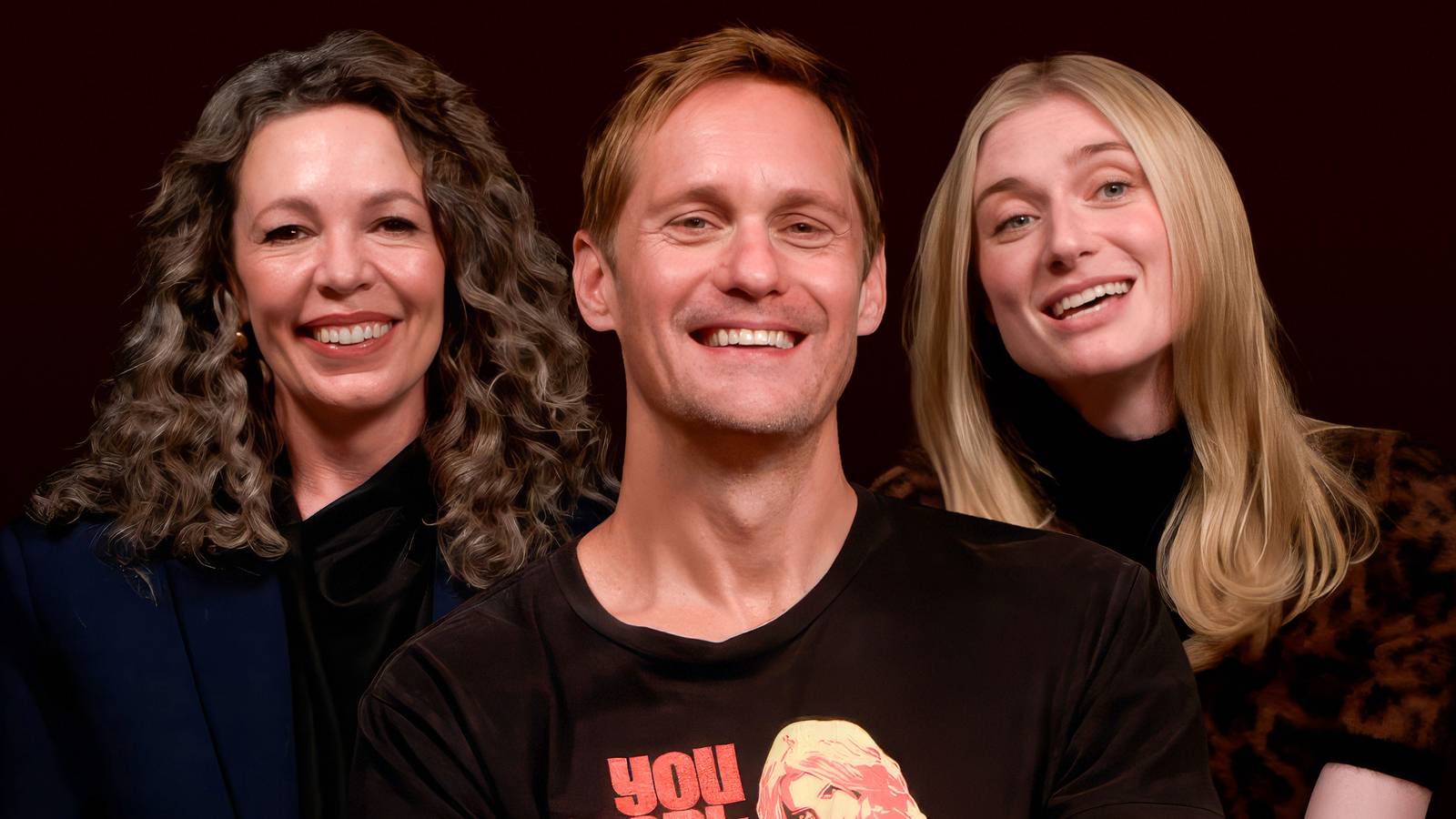
Even if you haven't seen Wicker yet, you've likely encountered its buzz. The fantasy romance, directed by Alex Huston Fischer and Eleanor Wilson and adapted from Ursula Wills' short story, premiered at Sundance in January and has since become a cultural phenomenon. Its trailer, released seven months later, only fueled the anticipation. Now, with the film in theaters, the cast and directors are opening up about the scenes that define the story.
At its core, Wicker follows an ostracized Fisherwoman (Olivia Colman) who, in a moment of desperation, commissions a Wicker Husband (Alexander Skarsgård) from the village's Basket Weaver (Peter Dinklage). Their instant marriage leads to a passionate, bed-breaking consummation that shocks the village—especially the Tailor's Wife (Elizabeth Debicki), whose own unhappy marriage becomes glaringly apparent. The film's blend of fable and bawdy comedy has drawn comparisons to Yorgos Lanthimos, but the directors say the humor emerged naturally.

"Anytime we think about a movie, the first question is: can it be funny?" Fischer told Collider. "The short story was a gift with its five-act structure, and we just tried to imagine how each character would actually behave." Wilson added that the source material hinted at humor, like a line about the broken bed after the wedding night. "We were like, 'Excuse me? What happened?'" she recalled.
The directors admit that writing the love scenes was initially a challenge. "We'd ask each other, 'Do you think we should write the scene where the bed breaks?'" Fischer said. "It would be easy to fade to black, but where's the fun in that?" The result is a surprisingly steamy sequence that evolved on set with intimacy coordinator Ita O'Brien. "We were blushing while shooting," Fischer confessed. "It took on a dimension we hadn't anticipated."
Wilson emphasized the honesty of the film's sex scenes. "Sex is funny and strange and awkward," she said. "It's a feminine perspective—not just skin. In the first scene, there's no music, and it's shocking and joyous." Fischer praised Colman's performance, noting that her face conveys the surprise and delight of the moment.
The film's third-act reconciliation is another pivotal moment, one that required careful tonal balance. "We wanted to earn the emotional payoff," Wilson explained. "It's a fable, but it had to feel human." The directors worked closely with the cast to ensure the reconciliation felt earned, not saccharine.
Elizabeth Debicki's Tailor's Wife is a polarizing character, but the directors gave her depth. "She's not just a villain," Fischer said. "She's deeply unhappy, and that drives her actions." Debicki brought nuance to the role, making the character's jealousy and desperation palpable.
For fans of fantasy romance, Wicker offers a unique blend of humor and heart. As the film continues to captivate audiences, the directors hope it resonates beyond its fairy-tale trappings. "We wanted to make it as human and tangible as possible," Fischer said. "And apparently, people are responding to that."
For more on the film's success, check out Olivia Colman's surprise box office debut. And if you're in the mood for more fantasy, explore fantasy novels every reader should experience or revisit the 2010s' most flawless fantasy TV shows.