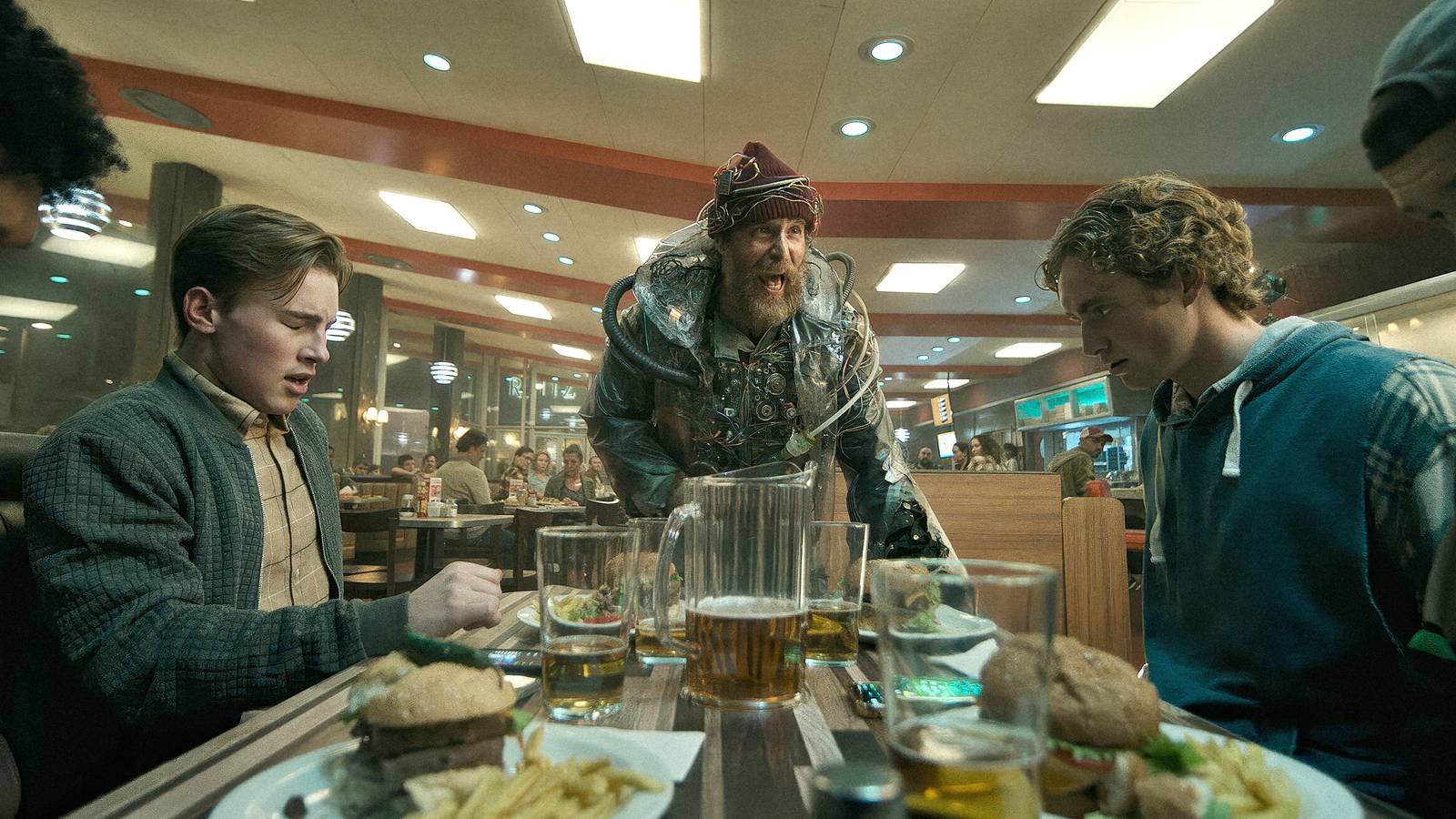
Gore Verbinski's latest black comedy, Good Luck, Have Fun, Don't Die, starts with a bang—or rather, a hostage situation. A wired-up time traveler (Sam Rockwell) bursts into a Los Angeles diner, recruiting a motley crew of strangers for a mission to stop a rogue AI from ending the world. But what makes the film truly memorable is how it ends: not with an explosion, but with a quiet, cyclical moment that redefines the entire story.
The film's unnamed protagonist, a manic yet oddly heroic figure from the future, arrives covered in tangled wires and plastic. He insists that the diner's patrons—a disillusioned teacher (Michael Peña), a struggling educator (Zazie Beetz), a grieving mother (Juno Temple), and a woman with a physical aversion to technology (Haley Lu Richardson)—are the perfect team to save humanity. Through flashbacks, writer Matthew Robinson reveals how each character has been broken by technology's relentless march, from AI-addicted students to a tragic cloning experiment. These backstories, reminiscent of the dark twists of anthology series, ground the film in relatable pain.

As the group embarks on their chaotic mission, the film builds toward what seems like a standard action climax. But Verbinski and Robinson subvert expectations. Instead of a triumphant explosion or a heroic defeat of AI, the ending loops back to the beginning: the time traveler re-enters the diner, sits down, eats Ingrid's eggs, and hands her a business card. The cycle will continue. It's a Groundhog Day-esque twist that could feel like defeat, but it's actually the film's most profound statement.
This ending argues that fighting technology isn't about destroying it—it's about learning to coexist. The average person can't blow up an AI or stop progress. What they can do is protect their humanity, one small act at a time. By centering the finale on a quiet, human moment rather than a CGI spectacle, the film delivers a message that's both realistic and hopeful. It's a reminder that the most perfect final shots often come from restraint, not excess.
The choice to avoid a conventional victory is risky, but it pays off. The film doesn't pretend that technology's dangers can be vanquished in a single battle. Instead, it offers a more sustainable solution: resilience, connection, and the courage to keep trying. For a story about saving the world, Good Luck, Have Fun, Don't Die ends up saving something even more important—the human spirit.
In an era of blockbuster finales that rely on explosions and CGI, Verbinski's film stands out by trusting its audience to appreciate a quieter, more thoughtful resolution. It's a landing that sticks because it refuses to betray the film's core theme: that the fight for humanity is won in everyday moments, not in epic showdowns. For fans of genre storytelling that takes risks, this ending is a masterclass in narrative payoff.