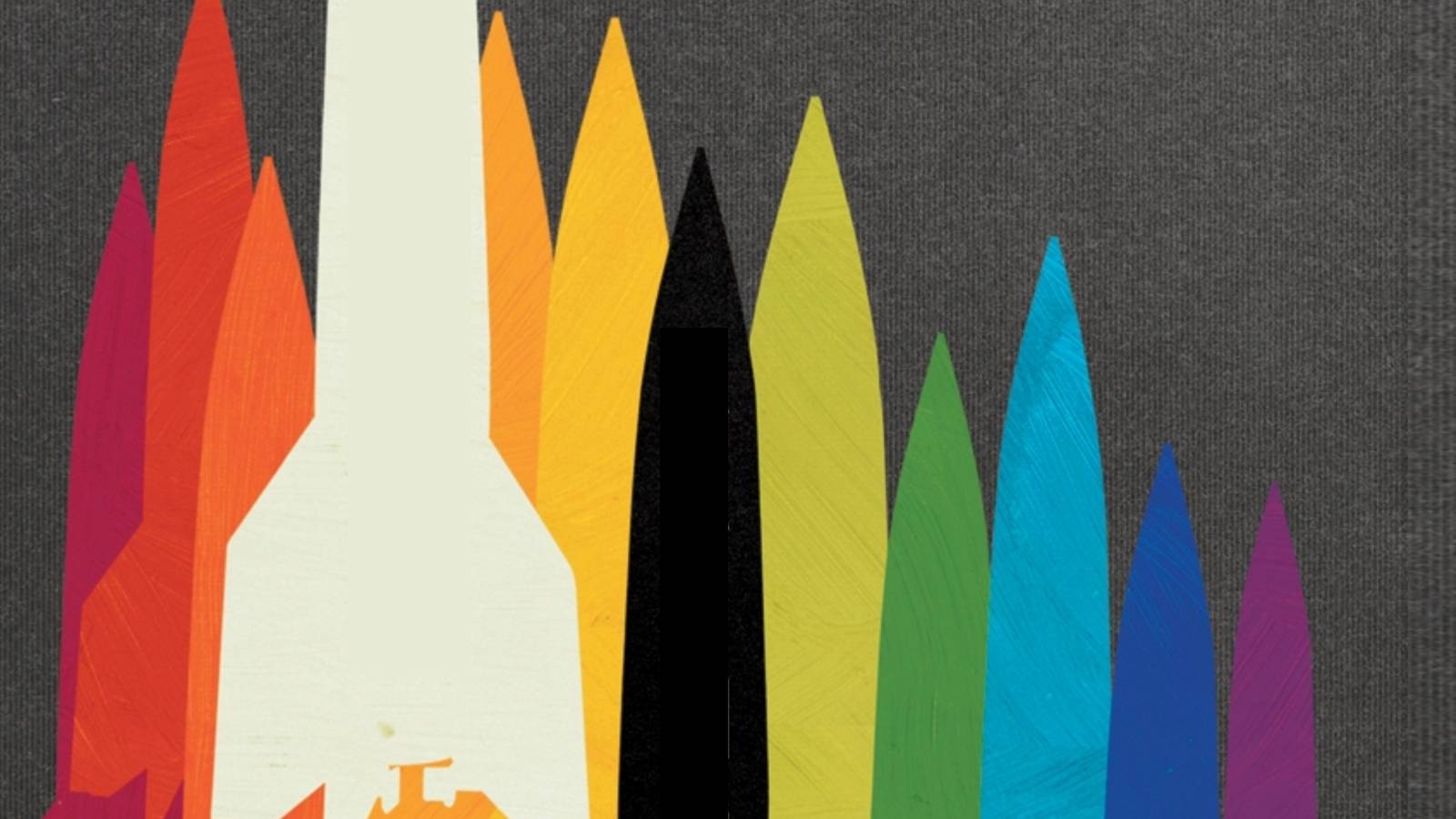
Postmodernism is one of those slippery terms that means different things in different art forms, but in literature, it's a movement that took the already experimental tendencies of modernism and cranked them up to eleven. These are books that play with language, structure, and reality itself—often leaving readers delightfully disoriented. The genre really took off in the 1950s and peaked over the next two decades, producing some of the most important novels of the 20th century. Here are the 10 best postmodern books of all time, ranked.
10. Mason & Dixon (1997) by Thomas Pynchon
You probably expected to see a certain Pynchon novel on this list—the one that got a shout-out in Knives Out. That one's coming. But first, here's another of his masterpieces. Mason & Dixon is challenging, but not because of disturbing content. Instead, it's the language that throws you: Pynchon writes in an 18th-century style that both honors and parodies the literature of that era. Once you adjust, it's a surprisingly straightforward story about Charles Mason and Jeremiah Dixon, the surveyors who mapped the Mason-Dixon line. It's weird, compelling, and worth the effort.
9. The Curious Incident of the Dog in the Night-Time (2003) by Mark Haddon
Not all postmodern books have to be grim and confusing. This one works as a perfect introduction to unconventional literature for younger readers—think of it as postmodernism with training wheels. The story follows a teenage boy with a unique way of seeing the world who becomes obsessed with solving the murder of a neighbor's dog. The first-person narration, combined with maps and diagrams, makes this both a solid mystery and a modern classic.
8. Underworld (1997) by Don DeLillo
The search for the Great American Novel may never end, but Underworld is a strong contender. The plot sounds simple: it follows a baseball—the one hit by Bobby Thomson in the 1951 Shot Heard 'Round the World—as it passes through different hands over decades. But DeLillo structures the book backward, starting in the 1990s and jumping back ten years with each section until we're in the 1950s. That nonlinear structure, along with DeLillo's sprawling tangents, makes this a huge, overwhelming, and impressive read.
7. Lolita (1955) by Vladimir Nabokov
You know the subject matter, but the experience of reading Lolita is something else entirely. It's simultaneously witty and poetic, yet darker and more uncomfortable than you can prepare for. The genius—and the horror—is that Nabokov makes you feel manipulated by the narrator, just as he manipulates the young girl he calls Lolita. The effect is dizzying and harrowing, but persevering through this book is ultimately worth it.
6. The Unbearable Lightness of Being (1984) by Milan Kundera
With a title like that, of course it's postmodern. Kundera's novel explores love, art, and politics in Soviet-era Prague through a philosophical lens that constantly questions its own narrative. It's a book that makes you think even as it tells a deeply human story.
5. Slaughterhouse-Five (1969) by Kurt Vonnegut
Vonnegut's anti-war masterpiece is one of the most accessible postmodern novels. It follows Billy Pilgrim, who becomes unstuck in time and experiences his life—including the firebombing of Dresden—out of order. The fragmented structure mirrors the trauma of war, and the famous refrain "So it goes" captures the absurdity of death. It's funny, heartbreaking, and utterly original.
4. Infinite Jest (1996) by David Foster Wallace
This thousand-page behemoth is the ultimate postmodern challenge. It's set in a near-future where years are sponsored by products, and it weaves together a tennis academy, a halfway house, and a film so entertaining it kills anyone who watches it. The footnotes have footnotes, the plot is deliberately confusing, and the prose is dazzling. It's not for everyone, but for those who make it through, it's unforgettable.
3. Gravity's Rainbow (1973) by Thomas Pynchon
Here's the Pynchon novel you were waiting for. Gravity's Rainbow is infamous for its difficulty: it's over 700 pages, has a cast of hundreds, and jumps between World War II Europe and bizarre digressions about everything from Pavlovian conditioning to rocket science. It's also one of the most brilliant and influential novels of the 20th century. If you want to understand postmodernism, this is essential reading.
2. If on a winter's night a traveler (1979) by Italo Calvino
Calvino's novel is a postmodern puzzle box. It's about a reader trying to read a book called If on a winter's night a traveler, but every time he starts, the book cuts off and he has to start another. The result is a novel made up of ten different opening chapters, each from a different genre. It's a playful exploration of storytelling itself, and it's one of the most inventive books ever written.
1. Ulysses (1922) by James Joyce
Yes, it's technically modernist, but Ulysses laid the groundwork for everything postmodern. Joyce's stream-of-consciousness style, his use of parody and pastiche, and his willingness to break every rule of narrative make it the ultimate boundary-pushing novel. It follows Leopold Bloom through a single day in Dublin, but it's really about everything: language, identity, history, and the human condition. It's challenging, but it's also the most rewarding book on this list.
For more literary rankings, check out our list of the best dark fantasy books of all time or our ranking of the ultimate adventure book hall of fame.