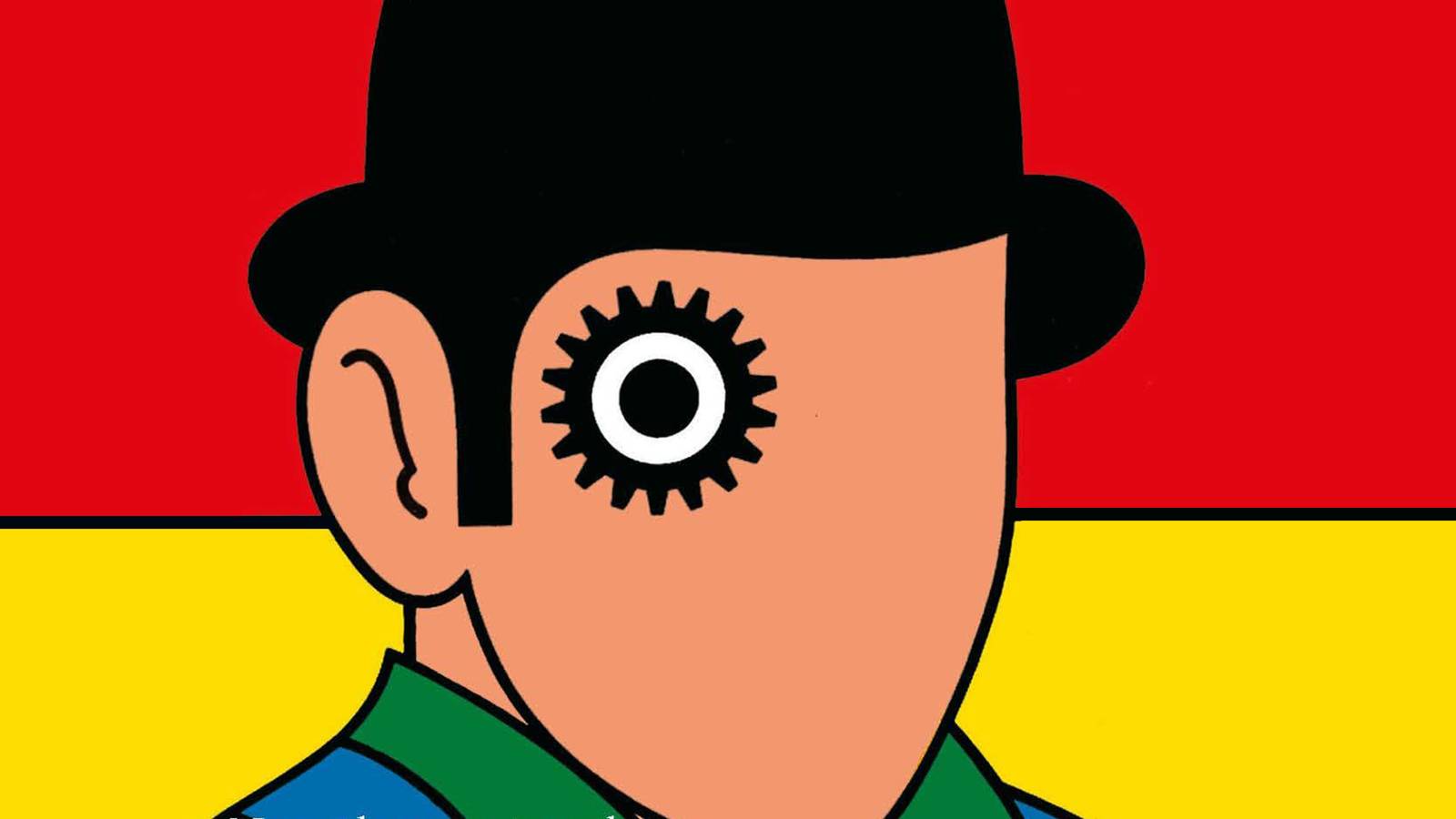
Before Stanley Kubrick's film adaptation stirred up so much controversy that the director himself pulled it from British circulation, A Clockwork Orange was a novel by English writer Anthony Burgess. Published in 1962, the classic sci-fi book is set in a near-future where youth engage in extreme violence and reformation is equally brutal. British critics were divided at the time—the Spectator called it an "extraordinary technical feat," while the New Statesman said it was a "great strain to read." Across the Atlantic, however, the reaction was far more positive, with the Tulsa World critic noting that the "story moves along rapidly and keeps you smiling even while heads are being bashed and stomachs kicked." But critics on either side of the ocean weren't reading the same book: the original UK version included Chapter 21, an ending that was cut from the U.S. edition when it was published in 1963.
A Dark and Violent Tale
The first 20 chapters follow Alex DeLarge, a 15-year-old delinquent who, with his gang of "droogs" (Pete, Dim, and Georgie), roams a dystopian London committing acts of "ultraviolence." These include unprovoked attacks, robbery, and sexual assault. After a particularly heinous crime at the home of a wealthy woman, his droogs abandon him, and Alex is captured by police. He is convicted of murder and sentenced to 14 years in prison.
After two years, Alex is offered a choice: serve out his sentence or participate in a government-led experimental aversion therapy called the Ludovico Technique. He volunteers for the latter, which involves being strapped to a chair with his eyes forced open, watching graphic films of extreme violence while under the influence of nausea-inducing drugs. The method creates a Pavlovian reflex, so that even the thought of violence—or the sound of Beethoven's music, which was once his passion—brings on nausea, sickness, and paralysis.
Alex is "cured," physically unable to commit his former acts of violence, and released. But karma has no such restrictions. He is beaten up by a homeless man he had abused before, and by Dim and Georgie, now policemen, who use their authority to beat him further. The sound of Beethoven from another room is the final straw, and Alex attempts suicide by jumping out a window. He survives, but the attempt sparks public outcry against the controversial technique, prompting the government to reverse the effects. When Alex awakes, he smiles at the assembled photographers and reporters, feigning reformation as he envisions returning to his old ultraviolent ways.
The Missing Final Chapter
That is where the American edition of the novel and Kubrick's adaptation end—a nihilistic, ambiguous ending that suggests Alex could never truly be reformed. The 21st chapter of the British edition changes that completely. In it, Alex is now eighteen and realizes it's time to settle down, get a job, a wife, and children. He has outgrown his life of crime. As Burgess explained (per Consequence):
"He grows bored with violence and recognizes that human energy is better expended on creation than destruction. My young hoodlum comes to the revelation of the need to get something done in life."
It's an undeniably more optimistic outcome—a happy ending that leaves the reader hopeful. Ironically, it was American publisher W.W. Norton that opted to remove this Hollywood-style ending, believing that dropping the final chapter made the story more convincing and powerful. They did so with Burgess's approval, although he later claimed he gave it under duress.
Contrary to popular belief, Burgess didn't hate the U.S. edition or the film, but rather how the film overshadowed his novel. He said, "Kubrick's achievement swallowed mine whole, and yet I was responsible for what some called its malign influence on the young." As for the ending, Burgess was largely ambivalent, protecting his original vision but acknowledging the "American" ending was stronger. It wasn't until 1986 that Chapter 21 was added to American editions, with Burgess ultimately allowing readers to decide which ending they preferred. In his introduction to the new edition, he wrote:
"Readers of the twenty-first chapter must decide for themselves whether it enhances the book they presumably know or is really a discardable limb. I meant the book to end in this way, but my aesthetic judgments may have been faulty."
So, whether you've read the original UK version or the American edition, the story of A Clockwork Orange remains a powerful exploration of free will and redemption. If you're a fan of thought-provoking sci-fi, you might also enjoy some mind-bending sci-fi novels or timeless sci-fi classics that never miss a beat. And if you're looking for more literary magic, check out classic books that deliver pure magic from first page to last.