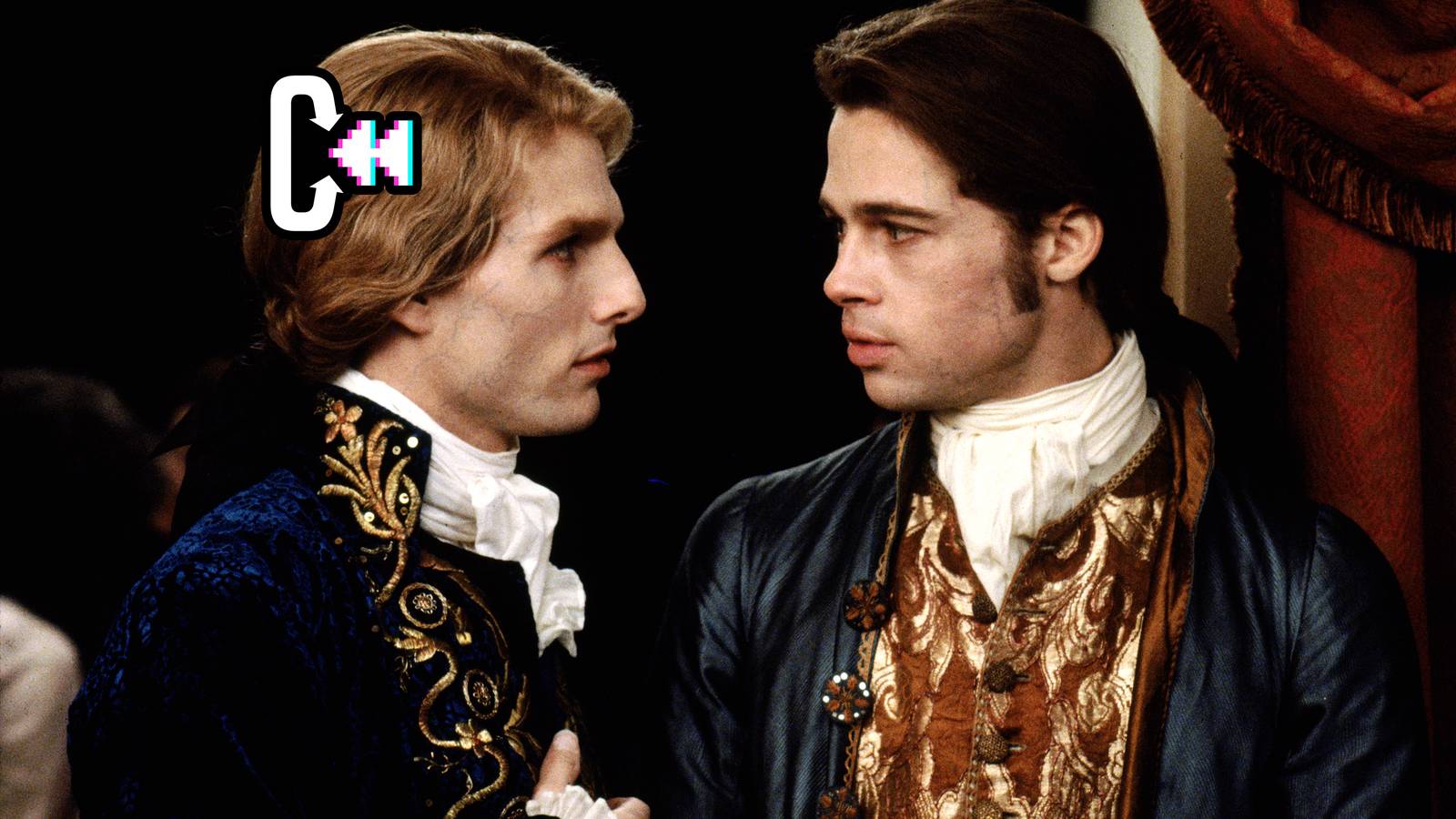
When Interview With the Vampire hit theaters in 1994, it was a landmark moment for gothic horror and queer representation on the big screen. The film, based on Anne Rice's bestselling novel, starred Brad Pitt as the brooding Louis and Tom Cruise as the charismatic yet menacing Lestat. Their relationship—a centuries-long, toxic, codependent union—was the heart of the story, though it was never explicitly sexual. In a recent exclusive interview with Collider, director Neil Jordan addressed whether a modern version of the film would depict Louis and Lestat's relationship more explicitly.
Jordan, who was speaking as part of the film's 4K restoration and the Collider Rewind retrospective, acknowledged that the boundaries for queer storytelling have shifted dramatically since the early '90s. However, he firmly believes that the film's approach was faithful to Rice's source material. "If you read the book, the level of sexuality and the use of the metaphor, let's put it, of blood for sex and semen and all that sort of stuff, the film is exactly like that," Jordan explained. He added that while a more flamboyant, overtly gay adaptation is possible, "that's not what she wrote. That wasn't in the book that I read, and that wasn't in the book that she wanted me to make as a movie."
For Jordan, the core of the story lies in the obsessive, destructive bond between Louis and Lestat. He described it as "two men who get obsessed," with one dominant and the other passive. The turning point comes when Louis finally gathers the courage to leave, and Lestat, in a manipulative move, turns a young girl named Claudia into a vampire. "So it's like a marriage between two men forever," Jordan said. "If that metaphor isn't clear to people, I don't know what it is."
The film's supporting cast, including Kirsten Dunst as Claudia, Antonio Banderas as Armand, and Stephen Rea as Santiago, helped bring this dark tale to life. The movie also featured Christian Slater as Daniel Malloy and Thandiwe Newton as Yvette. Over three decades later, the film remains a touchstone for vampire cinema, and its influence can be seen in recent projects like the AMC television series, which takes a more explicit approach to Louis and Lestat's relationship.
Jordan, however, remains unconvinced that explicit scenes would have made the film more powerful. "I can see how you could be more flamboyant. You could have sexual scenes between Louis and Lestat and all that stuff, but I'm not sure it would make it any more dynamic," he said. Instead, the film's power lies in its use of blood as a metaphor for desire and intimacy, a choice that was both a product of its time and a deliberate artistic decision.
For fans of the film, the 4K restoration offers a chance to revisit the lush, atmospheric world Jordan created. The director's comments also shed light on the challenges of adapting Rice's novel, which was groundbreaking in its own right for its frank exploration of queer themes. As Jordan noted, the story is ultimately about a relationship that is both monstrous and tragically human, a dynamic that resonates as strongly today as it did in 1994.
While the AMC series has reimagined Louis and Lestat for a new generation, Jordan's film remains a classic, rooted in the language and metaphor of Rice's original work. For those interested in exploring more vampire lore, check out our piece on why 'Vampire Academy' deserves a second life or the legacy of CBS's vampire programming. And for more on the film's production, see our story on Brad Pitt's ordeal on set.
Interview With the Vampire is now available on 4K UHD, and fans can look forward to more insights from the Collider Rewind series.