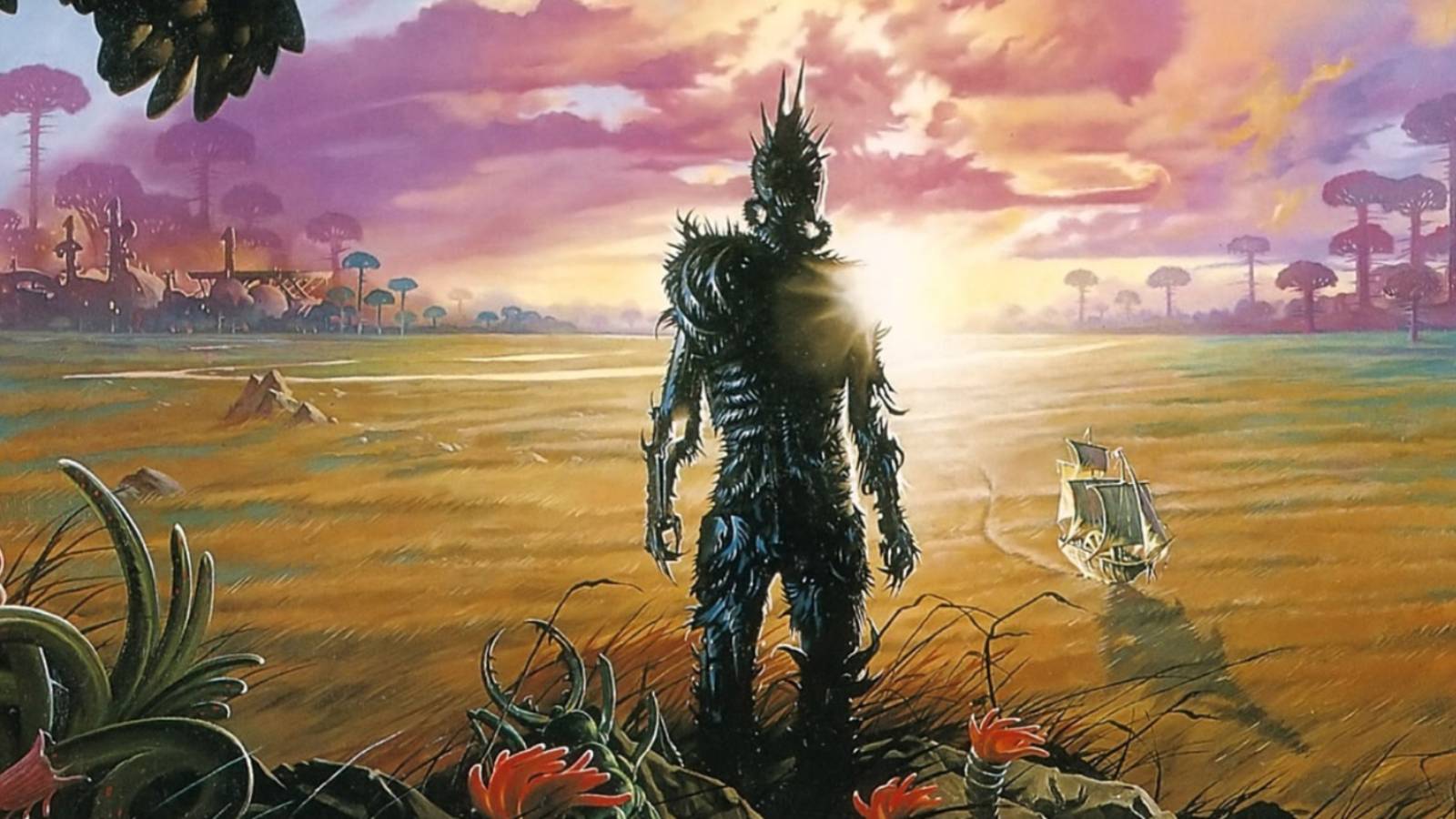
Frank Herbert's Dune isn't just a book; it's a cultural cornerstone. With its recent cinematic revival captivating a new generation, the saga of Paul Atreides and the desert planet Arrakis has cemented its status as a defining work of science fiction. But the vast universe of sci-fi literature holds other worlds just as rich, characters just as compelling, and ideas just as profound. For readers who've traversed the sands of Arrakis and crave another journey, here are ten monumental novels that stand shoulder-to-shoulder with Herbert's masterpiece.
10. Lucifer's Hammer (1977)
Larry Niven and Jerry Pournelle craft a gripping tale of celestial doom in Lucifer's Hammer. The novel meticulously charts the societal collapse and desperate survival that follows a catastrophic comet impact. While it begins as a tense disaster narrative, it masterfully transitions into a gritty post-apocalyptic epic, exploring how humanity rebuilds—or tears itself apart—in the ashes of civilization. Its detailed scientific grounding makes the catastrophe feel terrifyingly plausible.

9. Hyperion (1989)
Dan Simmons' Hyperion is a narrative marvel, structured as a pilgrimage where seven travelers share their profound connections to a mysterious, time-bending entity known as the Shrike. Each story is a self-contained gem of science fiction, ranging from cyberpunk noir to heartbreaking romance, all weaving together into a larger, awe-inspiring cosmological mystery. Its deep character work and philosophical weight make it a modern classic. For fans of intricate, character-driven epics, this is a must-read, much like the complex narratives found in expansive book-to-screen adaptations.
8. Under the Dome (2009)
Stephen King proves his mastery extends beyond horror with this mammoth sci-fi thriller. When an invisible, impenetrable dome suddenly seals off a small Maine town, the focus isn't solely on the mysterious phenomenon itself, but on the rapid and brutal disintegration of social order within. King delivers a devastating character study and a suspenseful page-turner, demonstrating that the most terrifying alien force can often be human nature under pressure.
7. Slaughterhouse-Five (1969)
Kurt Vonnegut's seminal work defies simple categorization. It is a semi-autobiographical war story, a profound philosophical treatise, and a brilliant work of science fiction, all delivered with the author's signature darkly satirical voice. The tale of Billy Pilgrim, who has become "unstuck in time" and experiences his life—including abduction by aliens—out of sequence, is a uniquely powerful exploration of fate, free will, and the trauma of war. Its influence on the genre is immeasurable.
6. Swan Song (1987)
Robert R. McCammon's epic post-apocalyptic novel is a haunting and ultimately hopeful journey through a world shattered by nuclear war. Following a diverse cast of survivors, including a young girl with a mysterious connection to the ruined Earth, the story blends stark realism with elements of dark fantasy and biblical allegory. Its sprawling scope and emotional depth invite comparison to the world-building of Dune, creating a landscape where the struggle for the soul of humanity is just as important as the struggle for survival.
5. Frankenstein (1818)
Mary Shelley's Gothic masterpiece is arguably the bedrock of modern science fiction. While often remembered as a horror story, Frankenstein is a deeply philosophical novel that grapples with the ethical limits of scientific ambition, the nature of creation, and the crushing weight of parental abandonment. Victor Frankenstein's quest to conquer death and his Creature's tragic search for belonging establish themes that every great sci-fi narrative, including Dune, continues to explore: the unintended consequences of power and the search for identity.
4. The Left Hand of Darkness (1969)
Ursula K. Le Guin's groundbreaking novel is a masterclass in anthropological science fiction. A human envoy arrives on the icy planet of Gethen, whose inhabitants are ambisexual, changing gender periodically. This brilliant conceit allows Le Guin to deconstruct our most fundamental assumptions about sex, gender, politics, and loyalty. Like Dune, it uses an alien culture as a lens to examine humanity itself, resulting in a story that is intellectually thrilling and emotionally resonant.
3. Neuromancer (1984)
William Gibson didn't just write a novel; he invented a genre and predicted a future. Neuromancer is the quintessential cyberpunk tale, introducing the matrix (a global computer network), cyberspace cowboys, and a gritty, high-tech, low-life aesthetic that defined decades of sci-fi to come. Its dense, poetic prose and breakneck plot, following a washed-up hacker hired for one last job, created a blueprint for how we imagine the digital age. Its cultural impact is as significant as Dune's in shaping the genre's direction.
2. The Three-Body Problem (2008)
Cixin Liu's modern masterpiece begins during China's Cultural Revolution and expands to a universe of staggering scale and existential dread. When humanity makes contact with an alien civilization from a chaotic triple-star system, the stage is set for a conflict that challenges the very foundations of physics and human morality. Renowned for its "hard sci-fi" concepts and cosmic perspective, this novel offers the same kind of mind-expanding scope and complex political intrigue that defines Herbert's work. It's a reminder that the best sci-fi can make you feel awe and terror in equal measure.
1. A Canticle for Leibowitz (1960)
Walter M. Miller Jr.'s profound novel spans millennia in a post-nuclear holocaust world. It follows a monastic order dedicated to preserving the scattered scientific and cultural knowledge of the fallen "Age of Flame." The book is a poignant, often darkly funny, meditation on the cyclical nature of history, the tension between faith and reason, and humanity's frustrating tendency to repeat its gravest mistakes. Its thematic depth and epic timeline offer a literary and philosophical weight that truly rivals the saga of the Atreides.
Each of these novels builds a universe as meticulously crafted as Arrakis, posing big questions about power, ecology, humanity, and destiny. They prove that while Dune may be a desert planet of its own in the sci-fi landscape, it is far from alone. The search for the next great read can lead you to post-apocalyptic wastes, cyberspace labyrinths, or distant galaxies—all offering adventures as unforgettable as the one that begins with the words, "A beginning is a very delicate time." For more explorations of gripping narratives across media, check out our look at perfect time travel stories or the latest on critically acclaimed genre series.