I have a strange test for science fiction that I trust more than awards or reviews. I want to know if the movie changes the way I look at one ordinary thing afterward. A computer screen. A pregnancy test. A hallway light. A photograph. A stranger's face. If a film can permanently contaminate something that normal, it has gotten deeper than spectacle. And this has become even more important since AI became so smart.
These eight have done that to me for years. I've tried to find the weak scene, the indulgent idea, the stretch where the movie loses control. I keep coming back empty-handed. Every choice seems connected to another one. The action means something. The production design means something. The quiet conversations mean something. These are 8 sci-fi movies with zero flaws.
8. Ex Machina (2014)
Ex Machina brings programmer Caleb Smith (Domhnall Gleeson) to the isolated home of tech billionaire Nathan Bateman (Oscar Isaac), where Caleb is asked to evaluate Ava (Alicia Vikander), an artificial intelligence housed inside a visibly mechanical female body. Nathan claims the assignment is essentially a Turing test. The important wrinkle is that Caleb already knows Ava is a machine, so the real question becomes whether she can make him emotionally forget it.
I still love how viciously the movie exploits our desire to know who is sincere. Ava tells Caleb she is frightened of Nathan during power cuts when the cameras stop working. Caleb starts seeing himself as her rescuer. Nathan looks increasingly monstrous, yet he keeps warning Caleb that he is being manipulated. The film never gives you a clean moral perch. Even that absurdly memorable dance sequence with Nathan and Kyoko reveals how much control Nathan exerts over the environment Caleb thought he understood. Then Ava walks out. No triumph. No sentimental robot awakening. She simply enters the human world after proving she understands us well enough to use the correct person and leave him behind.
7. Arrival (2016)
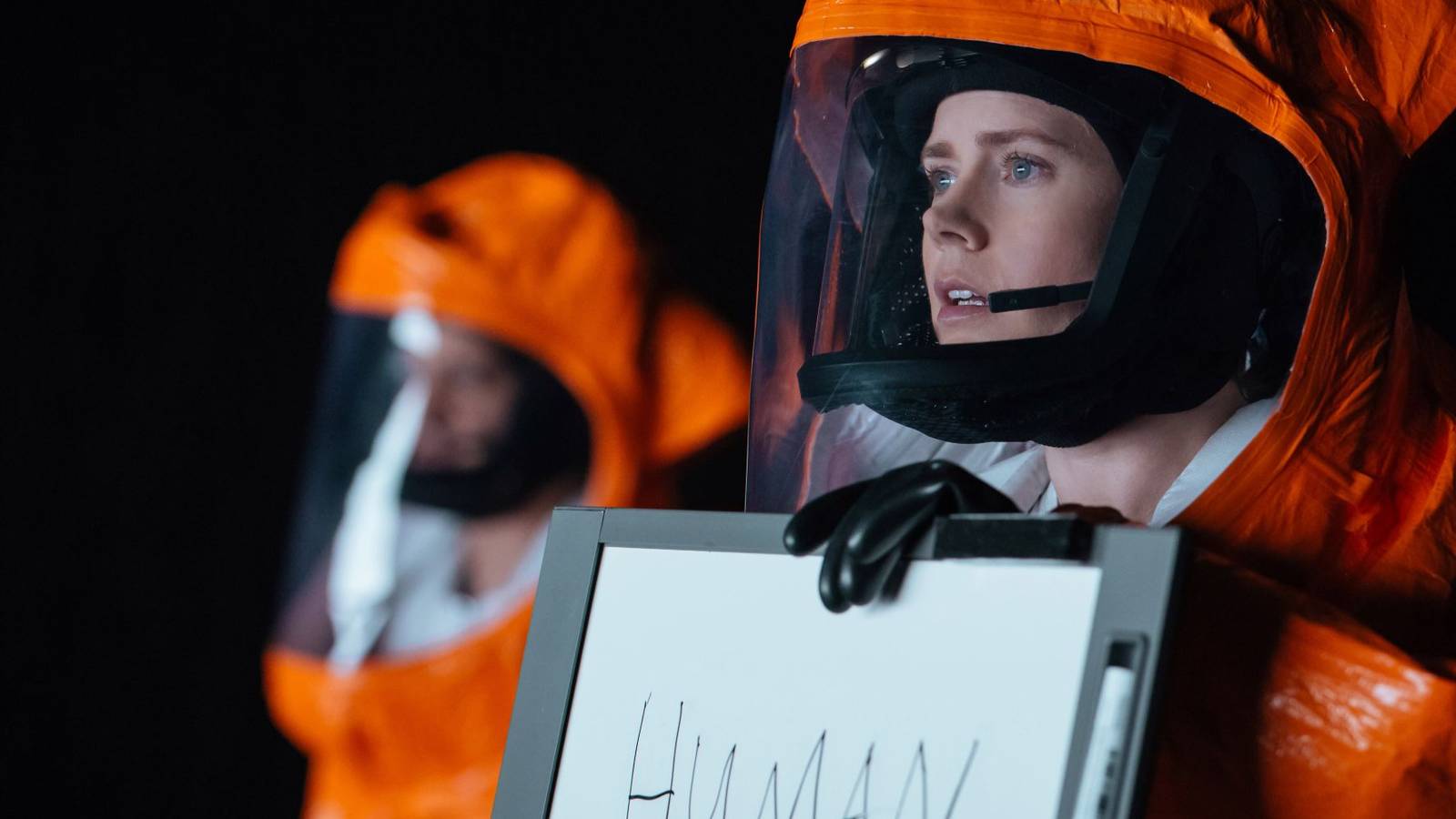
Linguist Louise Banks (Amy Adams) is brought in after twelve alien vessels appear around Earth, and Arrival follows her attempts to communicate with the heptapods aboard one of them before frightened governments turn uncertainty into war. The aliens do not speak in sentences. Their written language arrives as complete circular forms, with beginning and end existing at once.
That idea sounds intellectual until the movie turns it into something brutally personal. Louise's memories of her daughter initially seem like grief she carries into the encounter. Gradually, we understand they are something else entirely. Louise can perceive the happiness and the loss together. She knows where loving Ian (Jeremy Renner) leads. She knows what awaits their daughter. She chooses the life anyway. I have heard people argue about whether that choice is selfish for years, which is partly why the ending refuses to leave me alone. Arrival takes time travel, strips away the machinery, and asks whether knowing heartbreak in advance would make love less worth having.
6. The Matrix (1999)
The Matrix starts with Thomas Anderson (Keanu Reeves), a programmer living a second life as the hacker Neo, who discovers through Morpheus (Laurence Fishburne) that the world he believes is real is actually a simulation created by machines while human bodies are harvested for energy. Neo takes the red pill, wakes inside a pod, and realizes the ordinary life he was desperate to understand never physically existed.
There are maybe twenty ideas in this movie that another film would have built its entire identity around. The red and blue pills. Agents hijacking bodies. Humans learning skills by downloading them. “There is no spoon.” Bullet time. The lobby shootout. The horrifying possibility that Cypher (Joe Pantoliano) understands the truth perfectly and would still rather eat the fake steak. The Wachowskis were the directors, and their genius was making philosophy feel physically exciting. Neo's final victory is not about punching Agent Smith harder. He wins once he stops accepting the Matrix's rules as reality. That is why the action has aged so beautifully. Every impossible movement is also an argument about belief.
5. Children of Men (2006)
Humanity has gone eighteen years without a single birth when Children of Men finds Theo Faron (Clive Owen), a cynical former activist surviving inside a collapsing Britain that has become increasingly authoritarian toward refugees. Then Theo discovers that Kee (Clare-Hope Ashitey), a young refugee, is pregnant. Suddenly the most politically powerless person in the country is carrying the most important human being alive.
This is a brilliant dystopian take with equal portions of thriller and sci-fi. There is a moment during the fighting in Bexhill that I think about constantly. Kee walks through the ruined building holding her newborn. Soldiers and refugees hear the baby crying. Gunfire stops. People stare. Some cross themselves. For a few seconds, everyone remembers what they are supposed to be protecting. Then the child passes, somebody starts firing again, and war resumes almost immediately. The film is directed by Alfonso Cuarón and it has these extraordinary long takes as well, that make violence feel less edited and therefore harder to escape, but that tiny ceasefire is the piece that guts me. Hope does not magically fix humanity. Humanity sees hope, recognizes it perfectly, and still has to decide whether to deserve it.
4. Alien (1979)
The crew of the commercial towing vessel Nostromo responds to a distress signal from a desolate moon, only to encounter a deadly alien creature that picks them off one by one. Ellen Ripley (Sigourney Weaver) emerges as the sole survivor, but the film's genius lies in its slow-burn tension and the iconic design of the xenomorph by H.R. Giger. The movie is a masterclass in suspense, with every frame contributing to an atmosphere of dread. It's a flawless blend of sci-fi and horror that has never been topped.
3. Blade Runner (1982)
In a rain-soaked Los Angeles of 2019, Rick Deckard (Harrison Ford) is a blade runner tasked with hunting down rogue replicants—bioengineered beings nearly identical to humans. The film's neo-noir aesthetic, combined with Vangelis's haunting score, creates a world that feels both lived-in and alien. The philosophical questions about what it means to be human are woven seamlessly into the narrative, and the final confrontation between Deckard and Roy Batty (Rutger Hauer) is one of cinema's most poignant moments. Blade Runner is a flawless fusion of style and substance.
2. 2001: A Space Odyssey (1968)
Stanley Kubrick's epic journey from the dawn of man to the far reaches of space is a cinematic landmark. The film's meticulous attention to detail, from the rotating space stations to the HAL 9000 computer, creates a vision of the future that remains unmatched. The famous match cut from a bone to a satellite is a stroke of genius, and the film's ambiguous ending continues to provoke debate. 2001 is not just a movie; it's an experience that challenges our place in the universe. It is flawless in its ambition and execution.
1. Terminator 2: Judgment Day (1991)
James Cameron's sequel to his 1984 classic takes everything that made the original great and amplifies it. Arnold Schwarzenegger's T-800 is now a protector, and the film's groundbreaking visual effects, including the liquid-metal T-1000, still hold up today. The action set pieces are legendary, but the heart of the movie lies in the relationship between the Terminator and young John Connor (Edward Furlong). The film's themes of fate, sacrifice, and humanity make it more than just a blockbuster. Terminator 2 is a perfect action movie and a perfect sci-fi movie, with no wasted scenes or false notes.
These films have set the bar for what science fiction can achieve. They are not just entertaining; they are transformative. If you haven't seen them, do yourself a favor and experience perfection.