Uma Thurman has always had a unique relationship with stillness. She can sit across a table, barely move, and somehow make everyone else in the scene look like they are revealing too much. Then she can explode into something physical, funny, wounded, or completely deranged without the transition feeling announced. That quality is hard to fake.
It is why she can make a genetically perfect woman seem quietly ashamed of her own perfection, turn a milkshake conversation into sexual tension, and later spend two movies cutting her way through an entire revenge list without becoming a one-note action figure. There is also something wonderfully odd about the roles that found her. They are rarely comfortable women. Let's dig in right away into these 4 Thurman masterpieces.
4. 'Gattaca' (1997)
In a future where genetic engineering has made natural-born people second-class citizens, Vincent Freeman (Ethan Hawke) assumes the identity of genetically elite Jerome Morrow (Jude Law) to pursue his dream of traveling into space. At Gattaca Aerospace, Vincent meets Irene Cassini (Uma Thurman), another genetically selected employee who appears to belong perfectly inside this polished world but carries a heart condition that has already placed a ceiling on her future. Gattaca turns their relationship into one of the smartest parts of its whole argument because Irene is supposedly everything Vincent was told he could never be, yet she has also spent her life being reduced to a biological forecast.
Irene starts out cautious because that is how this society trains people to live. She secretly takes a strand of Vincent's hair to have his genome tested before letting herself get closer, which is such a nasty little detail because it shows how completely eugenics has invaded ordinary attraction. Later, when Vincent finally admits that he is not genetically valid, Irene has to confront how much faith she placed in the same system that has made her feel defective. Thurman keeps Irene composed enough that the sadness sneaks up on you. She is beautiful, healthy-looking, professionally successful, and still has been taught to think of herself as damaged goods. Vincent's rebellion becomes much richer once you realize Irene needs liberation from that logic too.
3. 'Kill Bill: Volume 2' (2004)
Beatrix Kiddo (Uma Thurman) has already crossed Vernita Green (Vivica A. Fox) and O-Ren Ishii (Lucy Liu) off her revenge list when Kill Bill: Volume 2 follows her after Budd (Michael Madsen), Elle Driver (Daryl Hannah), and finally Bill (David Carradine). The second half slows the revenge mission down and fills in the history underneath it, including Beatrix's brutal training with Pai Mei (Gordon Liu), her old relationship with Bill, and the pregnancy that made her abandon the assassination life before the massacre at the wedding rehearsal changed everything.
The burial sequence is where the movie strips Beatrix down to pure refusal. Budd blasts her with rock salt, injects her, locks her inside a coffin, and buries her alive. There is no sword, no army of enemies, no cool pose left. She lies in total darkness, remembers Pai Mei forcing her to punch wood from inches away, and starts working on the coffin lid until her knuckles split. That flashback gives the escape real weight because you understand exactly where the skill came from and how much it cost to learn. Then the final confrontation with Bill goes somewhere even better. They talk. They eat. Beatrix meets the daughter she believed she lost. The revenge story suddenly becomes a custody nightmare between two people who once loved each other. Thurman is fantastic there because killing Bill is no longer the difficult part. Sitting across from him and remembering why she loved him is.
2. 'Kill Bill: Volume 1' (2003)
The Bride (Uma Thurman) wakes from a four-year coma after surviving a massacre that left her pregnant body riddled with bullets, learns that her baby is gone, and begins hunting the former members of the Deadly Viper Assassination Squad who betrayed her. Kill Bill: Volume 1 is the first half of that revenge and the louder one, following Beatrix through Vernita Green, Hattori Hanzo (Sonny Chiba), Tokyo, O-Ren Ishii, and finally the House of Blue Leaves.
What makes Thurman so good here is that Beatrix can be absurdly cool without ever feeling emotionally vacant. The Vernita fight happens in a suburban living room and stops dead when Vernita's daughter gets home from school, forcing both women to hide knives behind their backs and pretend the room has not just been destroyed. Beatrix later goes to Okinawa and persuades retired swordsmith Hattori Hanzo to break his oath and make one final blade. Then comes the Crazy 88 fight, which should be exhausting and somehow keeps finding new ideas: severed limbs, silhouettes, broken furniture, a schoolgirl assassin with a bladed chain, blood spraying like the movie has discovered plumbing. Yet after all that, the showdown with O-Ren becomes quiet and almost graceful in the snow. Volume 1 keeps changing gears, and Thurman is the one person who makes every version of it feel like the same story.
1. 'Pulp Fiction' (1994)
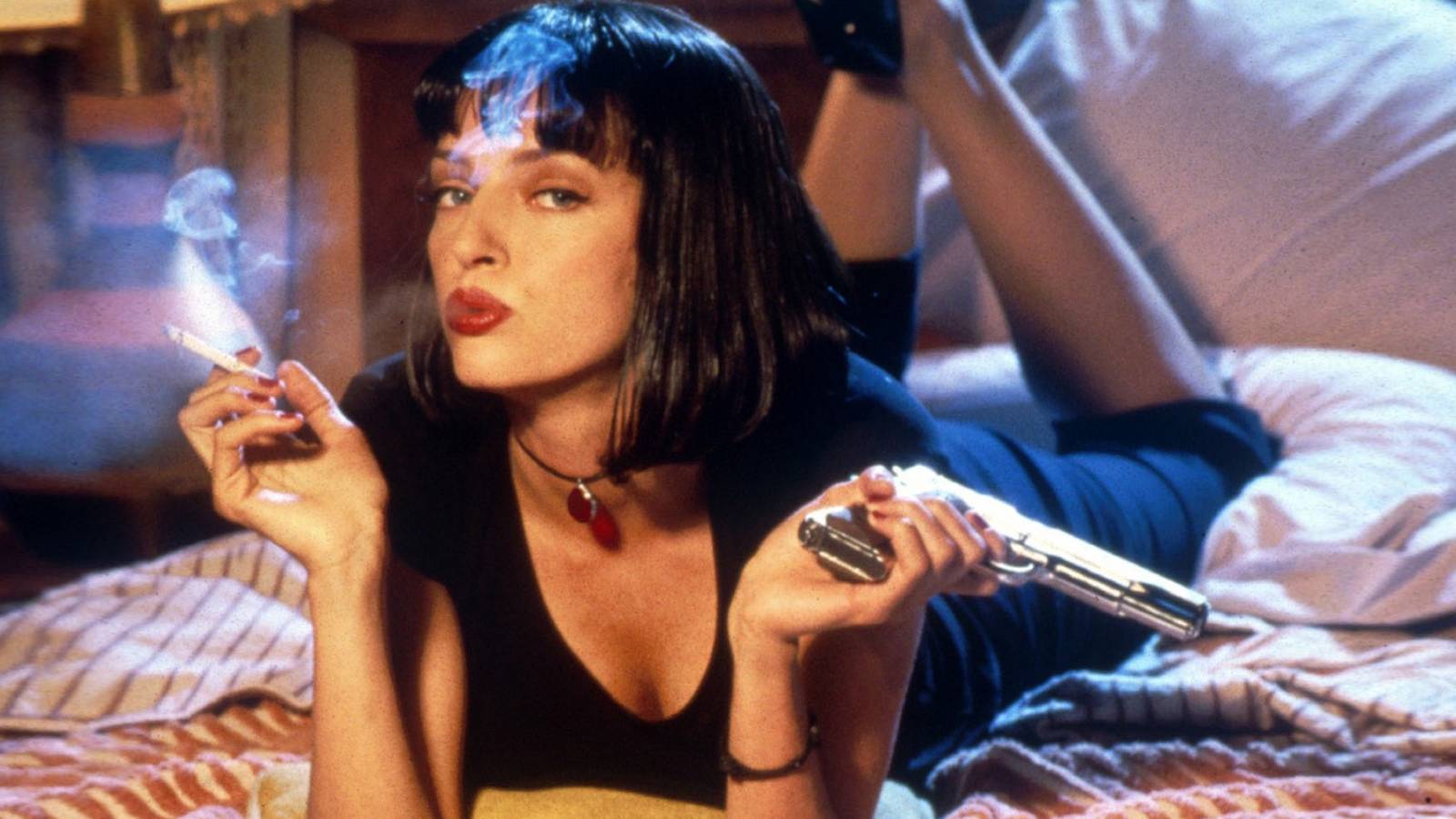
Vincent Vega (John Travolta) is ordered by mob boss Marsellus Wallace (Ving Rhames) to take Marsellus' wife Mia (Uma Thurman) out for the evening while the boss is away, which sounds simple until Pulp Fiction turns dinner, dancing, drugs, and one catastrophic mistake into the movie's most famous date from hell. Mia is introduced indirectly first. Vincent hears stories about her, worries about what Marsellus might think, and builds an entire idea of this dangerous woman before he even meets her.
When Mia finally appears, Thurman makes her an enigma wrapped in a bob haircut and a white shirt. She is playful, unpredictable, and utterly captivating. The dance contest at Jack Rabbit Slim's is pure charisma, and the overdose scene is a masterclass in panic and vulnerability. Thurman's performance is so iconic that it launched her into the stratosphere and remains a touchstone of 90s cinema. It's no wonder that Pulp Fiction is often cited as one of the must-see movies from 1980 to 2000. For more cinematic perfection, check out our list of Pixar's flawless filmography or Robert Pattinson's best movies.