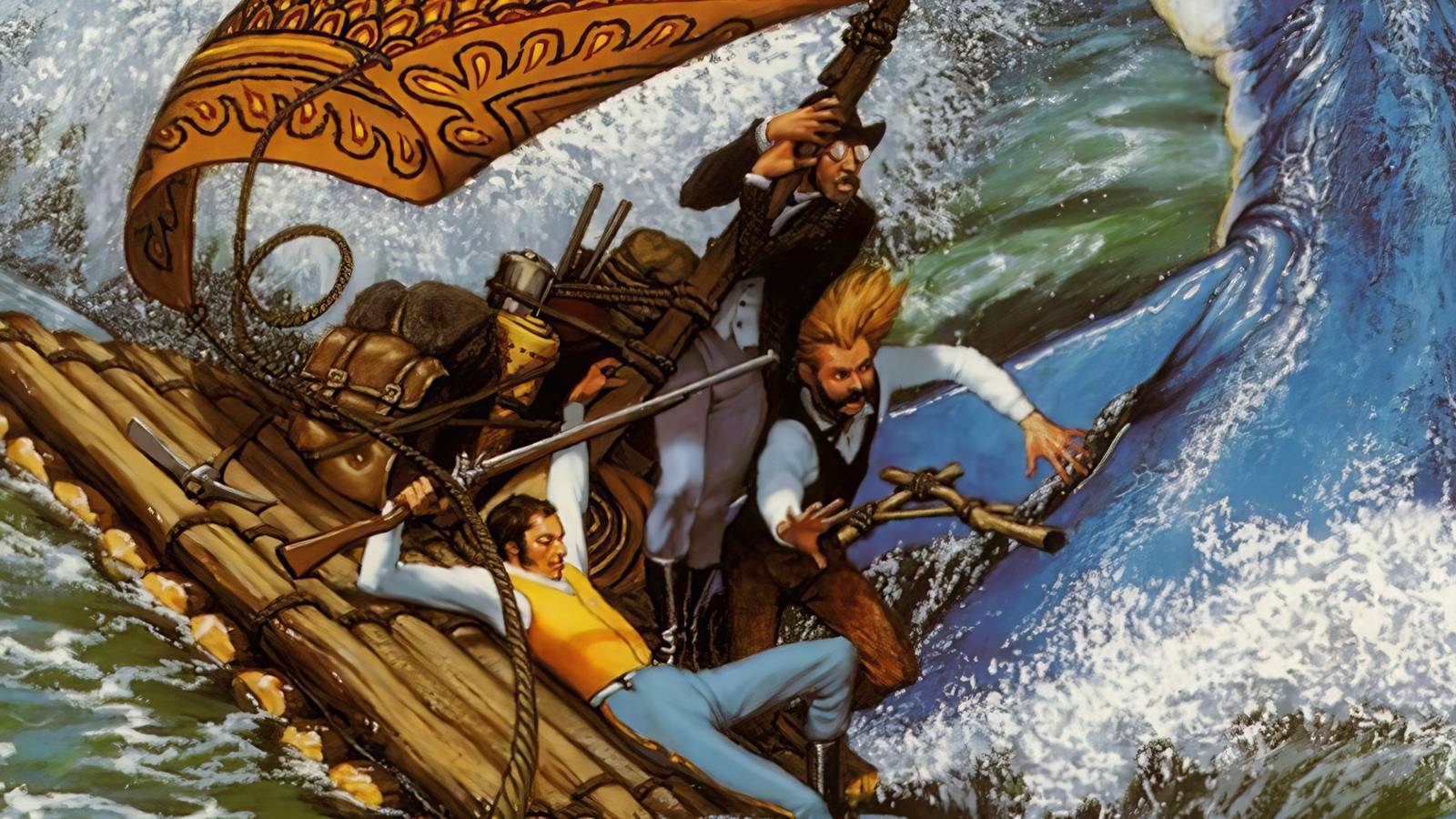
Adventure stories have always captured our desire to explore the unknown. For centuries, adventure novels have invited readers to sail across uncharted oceans, uncover hidden civilizations, duel fearless enemies, and survive impossible odds. So many movies and games have taken inspiration from them.
A few key books were central in shaping the genre's conventions, laying down blueprints that countless writers would follow. Whether introducing unforgettable heroes, pioneering entirely new subgenres, or digging deep with their themes, the titles on this list all left their mark on adventure storytelling.

10. Robinson Crusoe (1719)
"I learned to look more upon the bright side of my condition." One of the very first English novels ever, Robinson Crusoe tells the story of a sailor stranded alone on a deserted island after a shipwreck. Forced to survive using only his ingenuity and determination, Crusoe gradually builds shelter, cultivates crops, domesticates animals, and creates an entirely new life before eventually encountering the man he names Friday.
In the process, author Daniel Defoe transformed survival into the central engine of an adventure story, paving the way for an entire subgenre. (Indeed, the protagonist's name has come to be synonymous with being stranded and isolated in the wild.) Crucially, rather than relying on constant action, Defoe mined drama out of practical problem-solving, self-reliance, and the character's ability to adapt under extraordinary circumstances. You continue to see echoes of this in everything from Cast Away to The Martian.
9. Around the World in Eighty Days (1872)
"Anything one man can imagine, other men can make real." This banger is one of the defining works by the legendary Jules Verne. It follows the impeccably punctual English gentleman Phileas Fogg after he wagers that modern transportation has made it possible to circumnavigate the globe in just eighty days. Accompanied by his loyal servant Passepartout, Fogg embarks upon a whirlwind journey across continents while being pursued by a detective who mistakenly believes him to be a notorious bank robber.
Published in the 1870s, Around the World in Eighty Days captures the excitement of its moment in time, an age when the world was suddenly feeling more interconnected thanks to steamships, railways, and global communication. Every destination introduces fresh obstacles, colorful characters, and ingenious escapes, and the plot maintains a relentless pace throughout. All this makes it the archetypal modern globe-trotting adventure.
8. The Lost World (1912)
"I am a believer in the impossible." Although most famous for Sherlock Holmes, Arthur Conan Doyle also penned this classic sci-fi-edged adventure. Long before dinosaurs dominated pop culture (this book was published more than a century ago), The Lost World imagined an isolated South American plateau where prehistoric creatures continued to thrive. The eccentric Professor Challenger leads an expedition into this mysterious region, where the explorers encounter dinosaurs, ape-like beings, and civilizations untouched by the outside world.
Through this, Doyle essentially created the "lost world" subgenre. His emphasis on discovery and exploration established a template that would influence generations of adventure writers, filmmakers, and game designers. From King Kong and Jurassic Park to countless pulp adventures and fantasy epics, most stories about hidden civilizations and prehistoric ecosystems can trace much of their DNA back to this origin point.
7. Journey to the Center of the Earth (1864)
"Science, my boy, is made up of mistakes." Jules Verne strikes again, this time taking us deep underground rather than far overland. In Journey to the Center of the Earth, Professor Otto Lidenbrock discovers an ancient manuscript describing a route into Earth's interior. He promptly organizes an expedition with his nephew Axel and their Icelandic guide Hans. As they descend beneath extinct volcanoes, the trio discovers a breathtaking world of subterranean oceans and prehistoric animals.
The imagination and world-building here are off the charts. It's all very fantastical, hitting us with one whimsical setting or creature after another, infecting us with its boundless spirit of exploration and possibility. Verne wants us to see the magic in things again, to believe that the world still contains unimaginable mysteries waiting to be uncovered. He more than succeeds.
6. Treasure Island (1883)
"Fifteen men on the dead man's chest. Yo-ho-ho, and a bottle of rum!" No story has shaped the popular image of pirates more profoundly than Robert Louis Stevenson's Treasure Island. Narrated by young Jim Hawkins, the story begins when an old sea captain leaves behind a mysterious treasure map, sending our protagonist searching for buried pirate gold. Along the way, he encounters mutiny, betrayal, naval battles, and one of literature's greatest villains, the charismatic Long John Silver.
It's not an exaggeration to say that this book pretty much invented the modern pirate adventure. All the genre's core ingredients are here: peg legs, parrots, buried treasure, treasure maps marked with an "X," tropical islands, mutinous crews. In a sense, almost every pirate tale since is either drawing from Treasure Island or deliberately subverting it. Not to mention, Long John Silver's complexity made him a deeply influential villain.
5. The Three Musketeers (1844)
"All for one, and one for all!" This is another story that's become so famous that it almost feels like a modern myth. The Three Musketeers follows the ambitious young d'Artagnan after he travels to Paris hoping to join the King's Musketeers. He quickly befriends the titular trio—Athos, Porthos, and Aramis—and together they become embroiled in political intrigue, duels, and romance, all while facing the cunning Cardinal Richelieu and the mysterious Milady de Winter.
Alexandre Dumas's novel is a masterclass in swashbuckling adventure, blending action, humor, and camaraderie. Its influence is immense, shaping everything from later adventure novels to films and even the video game antiheroes we love today. The phrase "all for one, one for all" has become a universal motto for teamwork and loyalty, and the book's structure—a young hero rising through adventure—has been copied countless times.
4. Moby-Dick (1851)
"Call me Ishmael." Herman Melville's Moby-Dick is often considered one of the greatest American novels, but it's also a monumental adventure story. It follows the obsessive Captain Ahab on his quest for revenge against the white whale that maimed him. The narrative is rich with detail about whaling, the sea, and the human condition, making it a dense but rewarding read.
While not a pure adventure in the traditional sense, its influence on the genre is undeniable. The idea of a relentless pursuit, a larger-than-life antagonist, and the vast, unforgiving ocean have inspired countless stories. Its themes of obsession, fate, and nature's power resonate in everything from Jaws to In the Heart of the Sea. Moby-Dick is a testament to the genre's ability to explore deep philosophical questions while still delivering thrilling action.
3. The Count of Monte Cristo (1844)
Another Dumas masterpiece, The Count of Monte Cristo is a tale of betrayal, imprisonment, and ultimate revenge. Edmond Dantès is falsely accused of treason and imprisoned in the Château d'If. After years of suffering, he escapes, discovers a hidden treasure, and reinvents himself as the wealthy and mysterious Count of Monte Cristo to exact vengeance on those who wronged him.
This novel is a sprawling epic that combines adventure with intricate plotting and moral complexity. It's a story about justice, mercy, and the corrupting power of revenge. Its influence can be seen in countless revenge thrillers and even in modern TV shows like Revenge and The Count of Monte Cristo adaptations. The idea of a wronged hero rising from the ashes to systematically dismantle his enemies is a trope that continues to captivate audiences.
2. The Adventures of Huckleberry Finn (1884)
Mark Twain's The Adventures of Huckleberry Finn is more than just a river journey; it's a profound exploration of freedom, morality, and society. Huck Finn, a young boy escaping his abusive father, and Jim, a runaway slave, travel down the Mississippi River on a raft. Their journey is filled with adventures, but also with deep reflections on race and humanity.
Twain's novel broke new ground in American literature, using vernacular speech and a child's perspective to critique the hypocrisy of the antebellum South. Its influence on adventure storytelling is immense, particularly in the coming-of-age subgenre. The river itself becomes a character, and the journey is as much internal as external. This book has inspired generations of writers and remains a cornerstone of American literature.
1. The Odyssey (c. 8th century BC)
At the top of the list is Homer's The Odyssey, the ancient Greek epic that laid the foundation for all adventure stories that followed. It tells of Odysseus's ten-year journey home after the Trojan War, facing Cyclopes, sirens, and other mythical creatures. It's a tale of heroism, cunning, and perseverance.
Every adventure story owes a debt to The Odyssey. Its structure—a hero's long journey filled with trials and obstacles—is the template for countless novels, films, and games. The concept of the "odyssey" as a metaphor for any long, eventful journey is directly derived from this epic. Its themes of homecoming, loyalty, and the struggle against fate continue to resonate. Without The Odyssey, there would be no Treasure Island, no Indiana Jones, and no Star Wars. It is the ultimate adventure, and its influence is immeasurable.
These ten books have not only entertained readers for centuries but have also shaped the very fabric of adventure storytelling. From the survival instincts of Robinson Crusoe to the epic voyage of Odysseus, they remind us that the spirit of adventure is timeless. For more on how these stories have influenced other media, check out our list of the best FPS games or the most heartbreaking video game deaths.