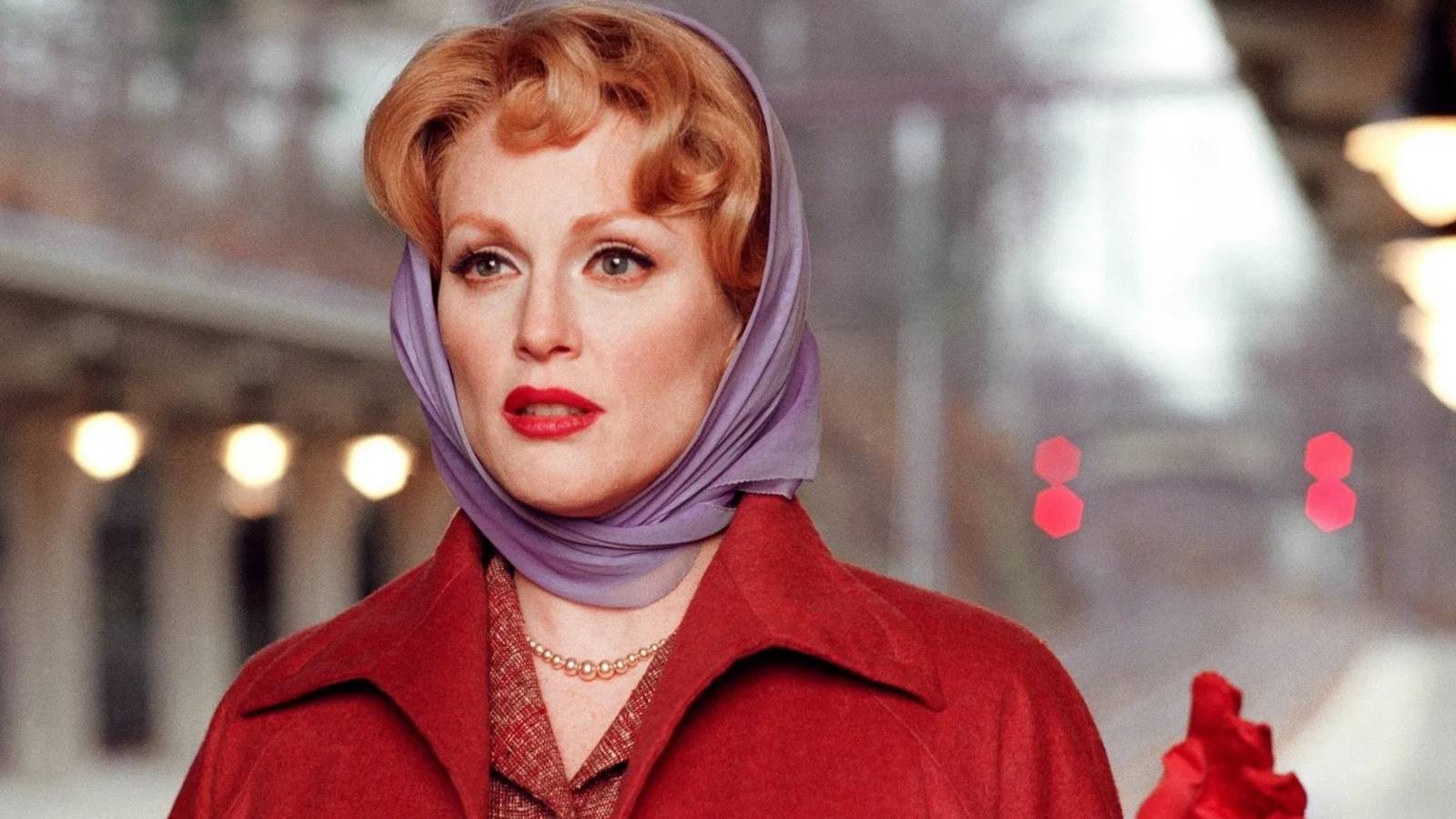
Julianne Moore possesses one of the most dangerous gifts an actor can have: she makes emotional exposure feel intelligent. Her characters are rarely simple victims, villains, mothers, lovers, or wives. There is usually something unstable under the surface, something private leaking into public life, and Moore knows exactly how to let that tension show without flattening the person into one clean idea.
That is why this list gets so stacked so fast. Moore fits each world differently, but the charge is always the same. She makes people readable and mysterious at once, which is why her best films keep gaining power the more you sit with them. Other than these six though, Moore has about 70 film credits to her name but these ones win for me.
6. 'The Big Lebowski' (1998)
The Big Lebowski is usually discussed through the Dude (Jeff Bridges), Walter Sobchak (John Goodman), bowling, ransom confusion, nihilists, and the Coens turning detective fiction into a stoned maze. Then Maude Lebowski (Julianne Moore) drops into the movie and changes the flavor of the whole thing. Moore takes a character who could have been a one-joke eccentric artist and makes her one of the smartest people in the room. Maude understands money, sex, image, inheritance, and the absurd male panic swirling around Bunny Lebowski (Tara Reid)’s disappearance.
What makes Moore so funny here is the absolute seriousness of Maude’s self-presentation. The flying harness, the art-world language, the clipped delivery, the refusal to treat the Dude’s confusion as important; all of it feels ridiculous and completely controlled. She wants a child, wants no romantic mess, and sees the Dude as useful in a way that somehow becomes both cold and hilarious. The movie’s chaos keeps pretending to be masculine, but Maude reads the situation cleaner than almost anyone.
5. 'May December' (2023)
May December is brutal because it understands how people turn scandal into a story they can survive. Gracie Atherton-Yoo (Julianne Moore) lives with Joe Yoo (Charles Melton), the man she began abusing when he was thirteen, and the film does something very uncomfortable with that history. It keeps the domestic surface calm enough to show how denial becomes routine. The house, the cakes, the kids, the polite conversations, the neighbors, the smiles; everything has been arranged around a lie that everyone knows and still steps around.
Moore’s Gracie is terrifying in ordinary ways. She can sound fragile, sweet, childish, wounded, maternal, and manipulative within the same conversation. Elizabeth Berry (Natalie Portman) arrives to study her for a movie role, and that turns the whole film into a sick mirror game about performance. Gracie has spent years acting as if her version of events is reality. Elizabeth watches, copies, judges, steals, and exposes the rot without becoming morally clean herself. Moore makes Gracie horrifying without turning her into a monster costume. That restraint is what makes the film sting and one of her best.
4. 'Children of Men' (2006)
Children of Men throws viewers into 2027, where human infertility has pushed the world into despair, authoritarian violence, refugee cages, and dead-end survival. Julian (Julianne Moore) is not in the movie for long, but her absence haunts the whole story. She leads the Fishes, a resistance group fighting inside a collapsing Britain, and she pulls Theo Faron (Clive Owen) back into action through a mission involving Kee (Clare-Hope Ashitey), the first pregnant woman in eighteen years.
Julian matters because the movie needs history before it can have hope. She and Theo once had a child, Dylan, and that loss still sits between them. Their car scene has that rare lived-in ache where jokes, resentment, memory, and old love all pass through the same few minutes. Then the ambush hits, and the film rips away the possibility of repair. Children of Men is a masterpiece of chaos and motion, but Julian’s character is the wound that makes the movement mean something and Moore plays it well.
3. 'Magnolia' (1999)
Linda Partridge (Julianne Moore) could have been swallowed by Magnolia’s enormous ensemble. Paul Thomas Anderson has dying fathers, damaged children, quiz-show ghosts, cops, addicts, gurus, regret, coincidence, and biblical weather all fighting for space. Moore cuts through the noise by making Linda’s guilt feel almost unbearable to watch. She married Earl Partridge (Jason Robards) for money, then somehow ended up loving him near the end of his life, and now that love has arrived too late to feel clean.
Linda’s pharmacy breakdown, not asking for sympathy in some neat way, being furious at the pharmacist, at the prescription, at the judgment she hears under every question, and really at herself for needing mercy after living so selfishly — the complete performance is huge, messy, profane, and spiritually naked. That is exactly what Magnolia needed.
2. 'Far from Heaven' (2002)
Far from Heaven uses the visual language of 1950s melodrama, but the feelings underneath are savage. Cathy Whitaker (Julianne Moore) has the perfect Hartford home, the successful husband, the polite children, and the social standing that comes with being a well-to-do housewife. But when she discovers her husband’s secret, her world begins to crack. Moore’s performance is a masterclass in restraint and vulnerability, as Cathy tries to maintain her composure while her life unravels. The film is a devastating look at the cost of conformity and the impossibility of true connection in a society that demands perfection.
Moore’s Cathy is both a product of her time and a woman ahead of it, struggling against the very structures that define her. Her quiet desperation, her longing for something more, and her ultimate acceptance of her fate make for one of the most poignant performances in cinema. Far from Heaven is a masterpiece of emotional precision, and Moore is its beating heart.
1. 'Still Alice' (2014)
In Still Alice, Julianne Moore delivers what is arguably her finest performance as Dr. Alice Howland, a renowned linguistics professor diagnosed with early-onset Alzheimer’s disease. The film follows Alice’s gradual decline, from forgetting simple words to losing her sense of self. Moore’s portrayal is heartbreakingly authentic, capturing the confusion, fear, and moments of clarity that define the disease. She makes Alice’s struggle deeply personal, showing how even the most brilliant mind can be undone by an unforgiving illness.
Moore’s performance earned her the Academy Award for Best Actress, and it’s easy to see why. She doesn’t play Alice as a victim; instead, she shows her fighting to hold onto her identity, her relationships, and her dignity. The film is a powerful reminder of the fragility of memory and the resilience of the human spirit. Still Alice is not just a movie about Alzheimer’s; it’s a profound meditation on what it means to be human, and Moore’s performance is its soul.