James Cameron has always been a visionary, but even by his standards, the tech he dreamed up for Aliens was startlingly prescient. The 1986 sequel to Ridley Scott's Alien didn't just give us unforgettable Xenomorphs; it gave us a gritty, lived-in future where the Colonial Marines' gear felt both cutting-edge and terrifyingly real. Now, two of the film's stars are revealing just how far ahead of its time Cameron's imagination truly was—and how the U.S. military took notice.
During a panel at Big Lick Comic Con NOVA, moderated by Collider's Maggie Lovitt, actors Ricco Ross (Private Frost) and Jenette Goldstein (Private Vasquez) reflected on the director's forward-thinking ideas. Ross highlighted Cameron's adaptation of the Steadicam concept for the Marines' heavy weapons, particularly the massive guns carried by Goldstein's Vasquez and Mark Rolston's Drake.

“That’s when they say, what is it? Life imitates art,” Ross said. “The Steadicam that Jenette and Mark would use in the film, the idea, the concept of having a Steadicam, so that the camera, even though you’re running and moving, it stays pretty steady on the site, and for James to think, ‘Let’s put a gun, a rifle on that, and then the target, even if you’re running, it will be there as well,’ was such a brilliant idea at the time.”
The result was a weapon rig that made the Marines feel like part of a specific military future—one where technology had advanced but everything remained heavy, dangerous, and physically demanding. Ross noted that the concept was so striking that it attracted outside interest. “So brilliant that I heard that the military asked him if they could use it,” Ross said, “because he actually made sure that he got the rights for that.”
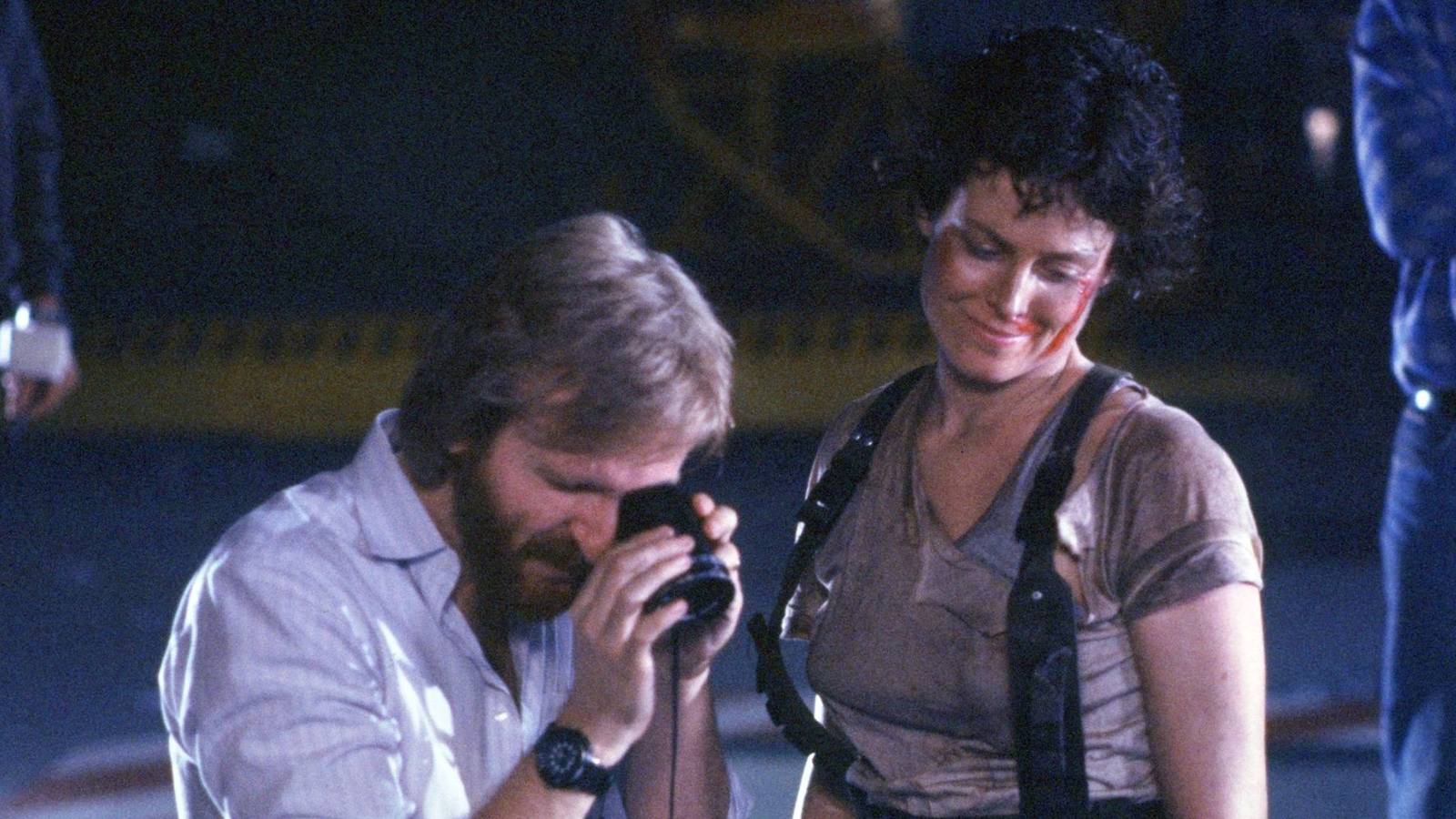
Goldstein, meanwhile, pointed to another Cameron innovation that seems almost obvious today because real-life technology eventually caught up. She brought up the small cameras used in the film, comparing them to what audiences would later know as GoPro devices. “The camera, the GoPro that everybody used. I mean, there was no such thing as a GoPro. It was this really cool idea he had. He was like, you know, 'What if there was a little camera, and you know, those big video cameras that you had in the ’80s were there,' and now we just think, like, 'Oh yeah, of course, a GoPro.'”
Cameron's habit of inventing tech to achieve his filmmaking visions is well-documented—just look at the numerous pieces of technology, VFX, and cameras he developed for Avatar: The Way of Water. But Aliens remains a standout example of how his forward-thinking designs can have real-world applications. The film's aesthetic—dirty, grimy, and built for soldiers to protect them against aliens—has aged remarkably well, never feeling like a dated vision of the future.
For fans of Cameron's work, this isn't the first time his ideas have crossed over into reality. His vision for The Terminator franchise also influenced real-world robotics and AI discussions. And while the military may have borrowed his Steadicam gun rig, it's a testament to how Cameron's world-building often blurs the line between science fiction and science fact.
Aliens is currently streaming on Hulu and Disney+, offering a perfect opportunity to revisit this classic and appreciate the tech that was years ahead of its time.