Horror trilogies face a unique challenge: the first film thrives on mystery, but sequels must expand the fear without diluting it. A truly great trilogy needs more than just three connected titles—it requires progression, a distinct identity, and enough thematic weight to make the journey feel intentional, not padded. These five trilogies approach that challenge from wildly different angles. None are gentle. All are worth the marathon.
6. The Blade Trilogy (1998–2004)
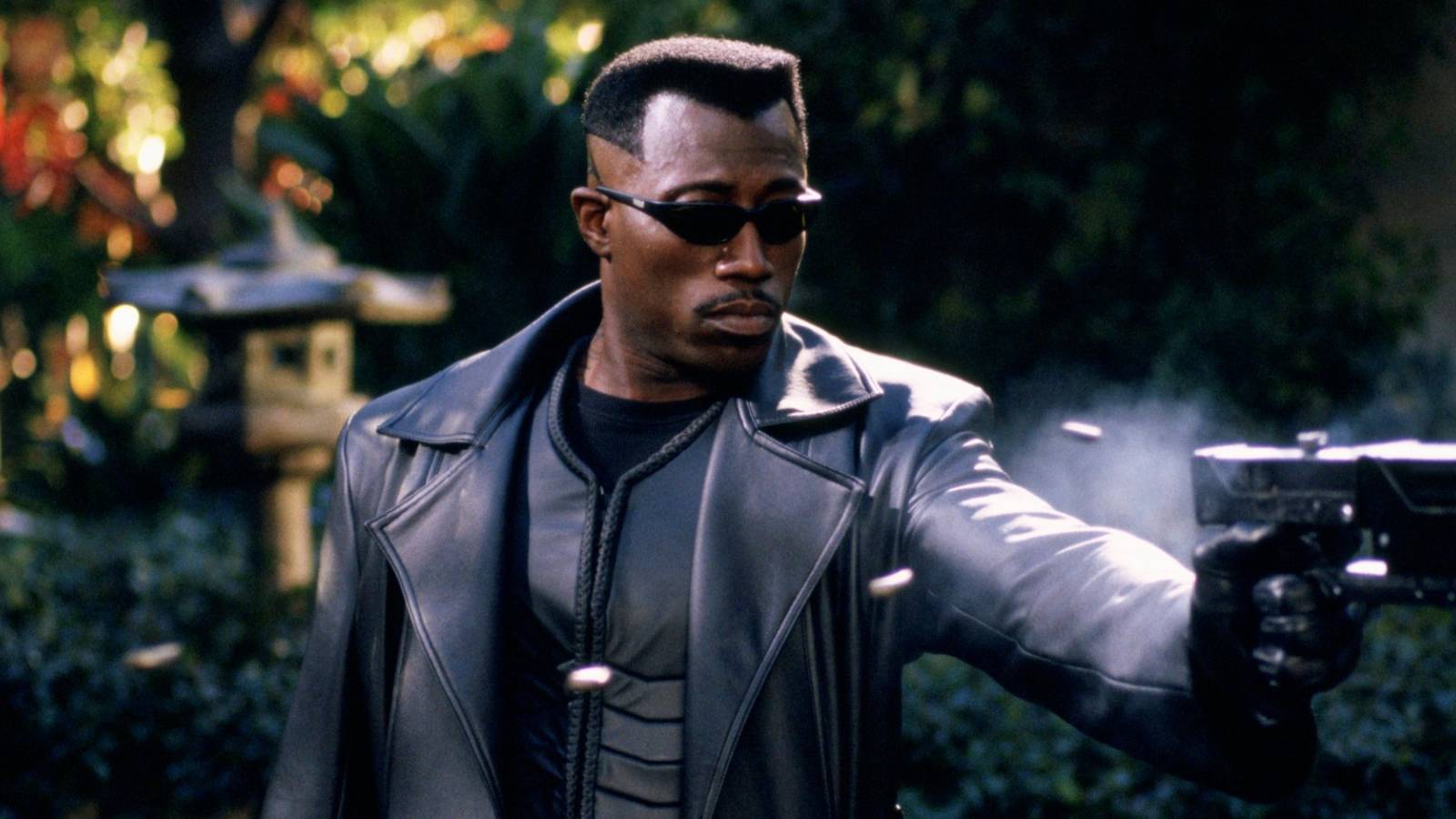
Long before superhero universes became Hollywood's safest bet, the Blade trilogy made a half-vampire warrior feel right at home in an R-rated action-horror world. Wesley Snipes stars as Blade, a dhampir hunting the vampires who killed his mother, using their own strength and speed against them. Blade II sees him in an uneasy alliance with vampires facing a more dangerous mutation, while Blade: Trinity expands the war by introducing Dracula and a new group of hunters.
The third film is messier than its predecessors, which keeps the trilogy from the top tier. But its legacy is enormous. Snipes brought a stillness and physical authority to the role that never needed explanation. Stephen Norrington's original turned blood-soaked nightclubs and martial arts into superhero language before the genre had a formula. Guillermo del Toro then pushed the sequel toward creature horror with the Reapers and their splitting jaws. Put this trilogy on for leather coats, silver weapons, vampire politics, and a reminder that comic-book cinema once had real teeth.
5. The Original Fear Street Trilogy (2021)
Netflix's Fear Street trilogy follows a group of teenagers trying to break the curse hanging over Shadyside, a town blamed for generations of massacres. Fear Street Part One: 1994 establishes the modern group and the rivalry with wealthy Sunnyvale. Part Two: 1978 moves to a summer-camp massacre, and Part Three: 1666 reaches back to the town's origins, connecting the timelines.
Releasing all three films across consecutive weeks turned the trilogy into a genuine event in the summer of 2021. Director Leigh Janiak used R.L. Stine's books as a foundation but aimed at an older audience. The result mixes teenage romance, slasher brutality, supernatural mythology, and class anger without losing the energy of a crowd-pleasing horror marathon. Kiana Madeira and Olivia Scott Welch give the story a relationship worth carrying across centuries, while Sadie Sink helps make the 1978 chapter especially painful. Fear Street understands how much fun horror can be when every masked killer, hidden tunnel, and old town secret feels connected. Watch all three close together—Shadyside works best when there's no escape between chapters.
4. The X Trilogy (2022–2024)
The X trilogy explores fame, youth, sex, aging, and self-invention through three films centered on women who refuse to accept the lives handed to them. X brings a small adult-film crew to a Texas farm in 1979, where Maxine Minx (Mia Goth) meets an elderly woman whose buried desires turn deadly. Pearl travels back to 1918 and shows the frustrated young dreamer behind that violence. MaXXXine moves into 1980s Hollywood as Maxine chases mainstream stardom while a killer stalks the city.
Mia Goth connects the trilogy through Maxine and Pearl, two women separated by time but driven by the same belief that ordinary life would be unbearable. Ti West changes genre with each chapter: X is a grimy slasher, Pearl a poisoned Technicolor melodrama, and MaXXXine embraces neon crime thrillers and Hollywood sleaze. The trilogy also understands performance as survival. Pearl creates fantasies because reality feels too small. Maxine turns certainty into armor and keeps walking toward the spotlight no matter what waits. Three movies, three decades, one ferocious hunger to be seen. Give them a weekend—you may never hear “I’m a star” the same way again.
3. The Apocalypse Trilogy (1982–1994)
John Carpenter's Apocalypse Trilogy is a thematic collection rather than a continuous saga. It starts with The Thing, which places an alien imitator inside an Antarctic research station and makes every human face suspicious. Prince of Darkness brings scientists and a priest into an abandoned church where an ancient force challenges the line between religion and theoretical physics. In the Mouth of Madness follows an insurance investigator searching for a missing horror novelist whose fiction may be rewriting reality itself. The threats change, but the destination remains humanity's possible extinction.
The progression is deliciously bleak. The first film asks whether a small group can recognize the end before it escapes. The second wonders whether science and faith can understand what's approaching. The third attacks reality, authorship, and sanity until the audience becomes part of the joke. Cosmic horror rarely feels this physical. Blood tests, shared dreams, mirrors, manuscripts, and impossible towns all suggest that human knowledge may be a very small light surrounded by something ancient. Watch these in release order after midnight—best sleep not guaranteed.
2. The Dead Trilogy (1968–1985)
Modern zombie cinema began here. George A. Romero's Dead trilogy—Night of the Living Dead, Dawn of the Dead, and Day of the Dead—redefined horror across three decades. The first film trapped strangers in a farmhouse as the dead rose. The second moved the action to a shopping mall, a satirical take on consumerism. The third descended into an underground bunker where scientists and soldiers clash over the undead's potential.
Romero used zombies as a mirror for societal anxieties: racial tension, mindless consumption, and the military-industrial complex. The practical effects, especially in Dawn and Day, remain benchmarks of gore and creativity. The trilogy's influence is immeasurable, shaping countless films and TV shows, including modern horror masterpieces. It's a must-watch for any horror fan, and it still holds up as a chilling, thought-provoking experience.
1. The V/H/S Trilogy (2012–2014)
Topping our list is the V/H/S trilogy, a found-footage anthology that pushed the boundaries of horror. The first film (2012) weaves multiple terrifying tapes around a frame story of criminals hired to steal a mysterious VHS. V/H/S/2 (2013) ups the ante with even more visceral segments, including the now-iconic “Safe Haven” from Gareth Evans and Timo Tjahjanto. V/H/S: Viral (2014) goes global, exploring the dark side of internet fame.
What makes this trilogy stand out is its raw, unpolished energy. Each segment is directed by a different filmmaker, offering a variety of styles and scares—from supernatural hauntings to cult rituals to body horror. The found-footage format adds a layer of realism that makes the terror feel immediate. The trilogy also captures the evolution of horror in the digital age, from analog tapes to viral videos. It's a rollercoaster of dread that rewards repeat viewings. For those who crave more scares, check out our list of the best horror movies since 2010. But for a complete, unsettling journey, the V/H/S trilogy is unmatched.