Film noir is often reduced to a checklist of visual clichés: shadows, cigarettes, Venetian blinds, femme fatales, voiceovers, corruption, rain on pavement. All true, but all incomplete. The best noir isn't a mood board—it's spiritual contamination. It's what happens when desire outsmarts morality and morality weakens under appetite. It's men talking themselves into ruin in full sentences, and women refusing to be reduced to the fantasies built around them—or weaponizing those fantasies so hard that men collapse under the weight of wanting.
So, what's the best film noir of all time? It depends on what kind of poison you think noir should deliver. These ten all have a real case, and not just because they're canonical or parked in textbooks. They're here because they understand that noir is about beautiful ruin.

The Big Heat (1953)
The Big Heat is noir with its patience burned off. While many great noirs seduce you first, letting the trap feel glamorous, this one starts with corruption and just keeps pulling at the thread until the entire civic fabric looks rotten. Dave Bannion (Glenn Ford) plays a cop whose life is detonated by his belief that institutions can contain filth if one decent man pushes hard enough. What makes it a legitimate "best ever" contender is how mercilessly it turns personal grief into civic rage. This isn't just a revenge story—it's about what a city looks like once polite corruption is forced into visible cruelty. Debby (Gloria Grahame) is essential: she's not just a gangster's moll with bite; she becomes the movie's great agent of retribution, a woman slowly realizing the ornamental role men assigned her can be turned back on them with terrifying force. The whole film feels like the genre dropping the pretense and going to war.
The Asphalt Jungle (1950)
The Asphalt Jungle could absolutely be someone's number one. It's one of the purest examples of noir treating crime as labor instead of fantasy. A heist is planned, specialists are assembled, and everybody brings a weakness to the job. The weakness matters as much as the skill. That's the movie. It sounds almost clinical, but there's greatness at play—the sadness inside every piece of criminal professionalism. These men aren't glamorous master thieves floating above consequence; they're tired craftsmen, opportunists, dreamers, low-rent aristocrats of illegality trying to turn precision into escape, only to find that human appetite always leaks into the machine. Doc Riedenschneider (Sam Jaffe)'s intelligence is real, but it can't save him from himself. Dix Handley (Sterling Hayden)'s rural fantasy gets sadder on each revisit because it's so nakedly doomed. Alonzo Emmerich (Louis Calhern)'s upper-class polish grows more pathetic. Marilyn Monroe's presence is often remembered as a historical footnote, but even she fits the film's larger argument about ornamental luxury sitting on top of economic and moral decay.
The Big Sleep (1946)
The Big Sleep has one of the strongest cases for this list if your definition begins with style as combat. It doesn't need complete solvability to win—it barely even needs coherence in the way lesser mysteries do. Instead, it runs on verbal rhythm, erotic intelligence, and the sensation that every room contains three games being played at once. Philip Marlowe (Humphrey Bogart) is perfect noir architecture: amused, sharp, tired, curious enough to get in trouble, and self-possessed enough to sound as though trouble is beneath him even while it's swallowing his schedule whole. Then Vivian Sternwood (Lauren Bacall) walks in, and the movie becomes dangerous in a second—not because the plot changes, but because the temperature does. The film's looseness feels like a statement: Marlowe is moving through a world too diseased to organize itself cleanly for his benefit. That's noir. The mess is part of the truth. The Big Sleep understands that confusion can be sexy if the people inside it are alive enough.
In a Lonely Place (1950)
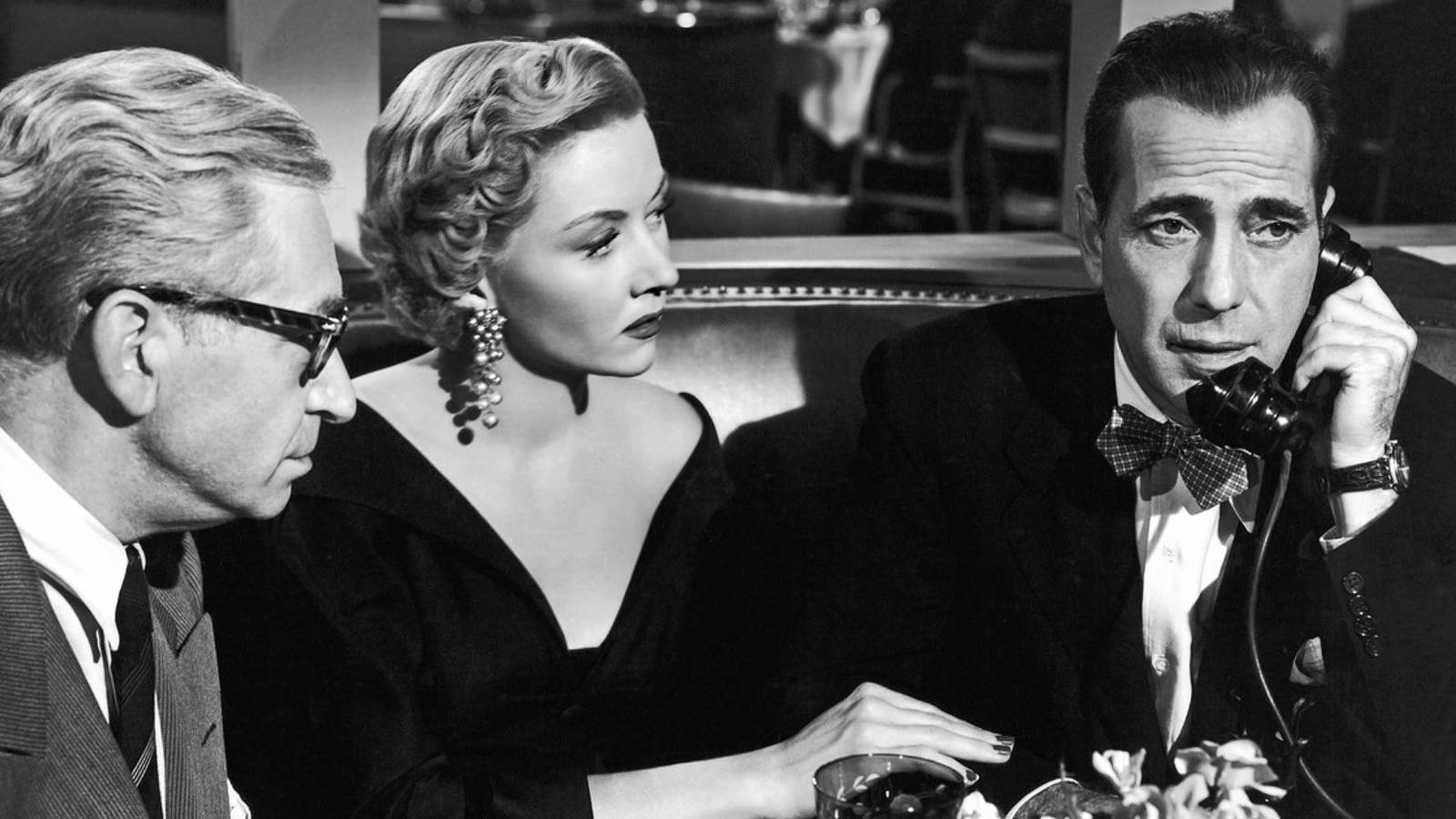
This is one of the greatest noirs because it turns the genre inward so ruthlessly. A murder investigation exists, but it almost feels secondary to the deeper, nastier question the film keeps asking: what if the man at the center of your love story really might be the kind of man who could kill you? In a Lonely Place has one of the most frightening performances in classic Hollywood because Dix Steele (Humphrey Bogart) isn't a monster in some flamboyant way. He's frightening because he's volatile, brilliant, funny, wounded, and intermittently tender in exactly the proportions that make love and fear nearly impossible to separate. That's richer than ordinary noir plotting—that's emotional noir at a very high level. And Laurel Gray (Gloria Grahame) is what makes the film truly devastating. The romance collapses because suspicion, once intimacy has let it in, starts contaminating every affectionate gesture. That's such an incredible noir move. The genre often tells us love is dangerous because the woman is a trap. Here, love is dangerous because the man may be irreparably broken in ways charm cannot stabilize. Noir rarely gets more emotionally adult than this.
Touch of Evil (1958)
Touch of Evil drops you into a world where rot has become institutional style. That opening shot deserves every bit of its myth, but what really gives it a claim to the top is how fully it understands moral contamination as environment. Borders matter, race matters, police power matters, sexual threat matters. The film is a masterpiece of paranoia and decay, where every character is compromised and every decision leads deeper into the mire. It's noir at its most baroque and its most urgent, a reminder that the genre's shadows aren't just aesthetic—they're political.
For more cinematic masterpieces, check out our list of 2026's Best Movies So Far and discover Hidden Gems: 10 Unexpected Movies That Rival Cinema's Greatest Masterpieces.