Martial arts television has come a long way from simply putting two skilled fighters in a room and letting the choreography do all the work. Obviously, great fights are still essential to the genre — if the movement looks too perfect, or the technique feels fake, the audience is going to notice immediately — however, modern martial arts shows also understand that a fight only lands when there is something behind it.
The genre has slowly evolved into focusing heavily on personal rivalries and philosophies long before anyone throws the first punch. That doesn’t mean older martial arts series suddenly feel outdated, though. If anything, the classics proved they could carry the genre long before modern shows started chasing bigger, faster fight scenes. The six shows on this list represent the best of both worlds and prove just how much martial arts television can do when the story is as strong as the action.
Warrior (2019–2023)
Warrior is a martial arts series that goes beyond great fight sequences and actually gives the audience a character to root for. The show, based on an original concept developed by Bruce Lee, drops viewers into San Francisco’s Chinatown during the Tong Wars of the late 1800s. The story follows skilled martial artist Ah Sahm (Andrew Koji), who arrives from China in search of his sister, Mai Ling (Dianne Doan). However, he gets recruited as a hatchet man for the Hop Wei tong and quickly finds himself stuck in the middle of a violent power struggle against the rival Long Zii.
Things become even messier once Ah Sahm discovers that Mai Ling isn’t exactly waiting to be rescued. In fact, she has built power of her own within Chinatown and is willing to play the same brutal political game as everyone else. The action in Warrior is obviously phenomenal, but Ah Sahm’s backstory adds weight to every kick. The build-up before a fight matters just as much as the speed and precision of the choreography. The series covers Chinatown politics, racism, immigration, labor conflict, and police corruption, which gives weight to the narrative. The audience knows that in this world, alliances can shift in seconds, and even the strongest fighter can end up on the wrong side of a brutal power play.
Bloodhounds (2023–2026)
Bloodhounds deserves way more recognition than it gets. The series builds its action around footwork and body shots instead of trying to show its characters utilizing superhuman techniques or flinging each other across rooms. This grounded approach to martial arts is one of the show’s greatest strengths, aside from its compelling narrative, of course. The story follows young boxers Kim Gun-woo (Woo Do-hwan) and Hong Woo-jin (Lee Sang-yi), who meet in the ring before becoming close friends. They soon find themselves entangled in Seoul’s criminal moneylending world after Gun-woo’s mother is targeted by a predatory loan operation run by Kim Myeong-gil (Park Sung-woong).
The friends eventually join forces with benevolent moneylender President Choi (Huh Joon-ho) to fight back, and that sets the stage for an epic saga about friendship and loyalty. The chemistry between Gun-woo and Woo-jin is honestly just as important as the central conflict. The two train, eat, and get beaten up together, but keep showing up for each other. Their bond gives the fights emotional stakes because the audience isn’t watching to simply see which side has the better technique. The series is a modern martial arts masterpiece because it respects the sport, but understands that the viewers need more than just that to keep tuning in.
Kung Fu (1972–1975)
Kung Fu is as old-school as it gets, but that’s what makes the show special. It aired long before martial arts became a regular part of Western action television, and has truly stood the test of time. The series follows David Carradine as Kwai Chang Caine, a half-Chinese, half-American Shaolin priest who flees China and travels through the Old West while searching for his half-brother, Danny (Tim McIntire). Most episodes place Caine in a new town where he encounters corruption, prejudice, or someone being exploited. Initially, he is always reluctant to fight, but when he decides that violence is unavoidable, his opponents have a tough time escaping him. Kung Fu unfolds with a restraint that modern martial arts have lost somewhere along the way.
Caine’s first instinct is rarely to prove that he is the toughest person in the room. The series keeps flashing back to his Shaolin training, where he learned patience and discipline alongside the actual fighting. Kung Fu actually drew many of its philosophical ideas from Taoist thought, including concepts associated with the Tao Te Ching. When a fight finally happens, it feels like the conclusion to a moral conflict rather than an action sequence inserted just for the heck of it. Of course, the choreography in the show is slower and more theatrical than what martial arts fans are used to today. However, that dated quality just adds to Kung Fu’s charm.
My Name (2021)
My Name wastes absolutely no time getting ugly and immediately hooks the audience in. The series follows Yoon Ji-woo (Han So-hee), whose life falls apart after her father is murdered right in front of her. Determined to find the killer, she joins a drug cartel and goes undercover as a police officer, training relentlessly to become a formidable fighter. The show’s action is brutal and visceral, with Han So-hee delivering a physically demanding performance that anchors the series. But what makes My Name a masterpiece is its emotional core: Ji-woo’s quest for revenge is fueled by grief and a desperate need for justice, making every punch and kick resonate with pain and purpose. The series also explores themes of identity, betrayal, and the cost of vengeance, elevating it beyond a simple action thriller. It’s a tight, eight-episode arc that proves martial arts can be a vehicle for deep character study.
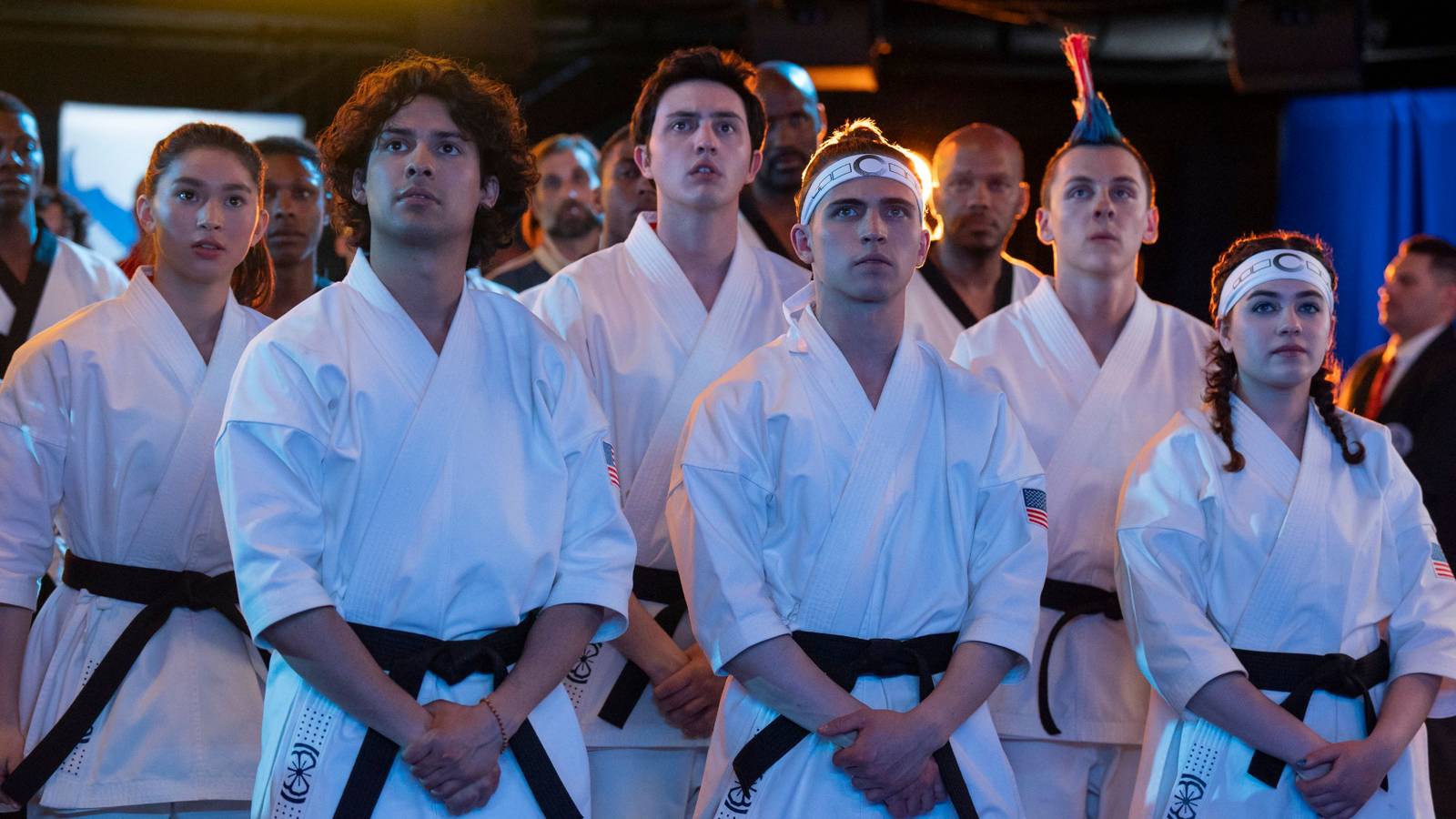
These shows, along with others like Cobra Kai and Into the Badlands, demonstrate that the best martial arts television isn’t just about the fights—it’s about the people throwing the punches. Whether it’s the historical drama of Warrior, the grounded realism of Bloodhounds, the philosophical depth of Kung Fu, or the raw emotion of My Name, each series earns its place as a 10/10 masterpiece by making every strike count. For more TV gems, check out our list of one-season mystery gems that are also perfect masterpieces.