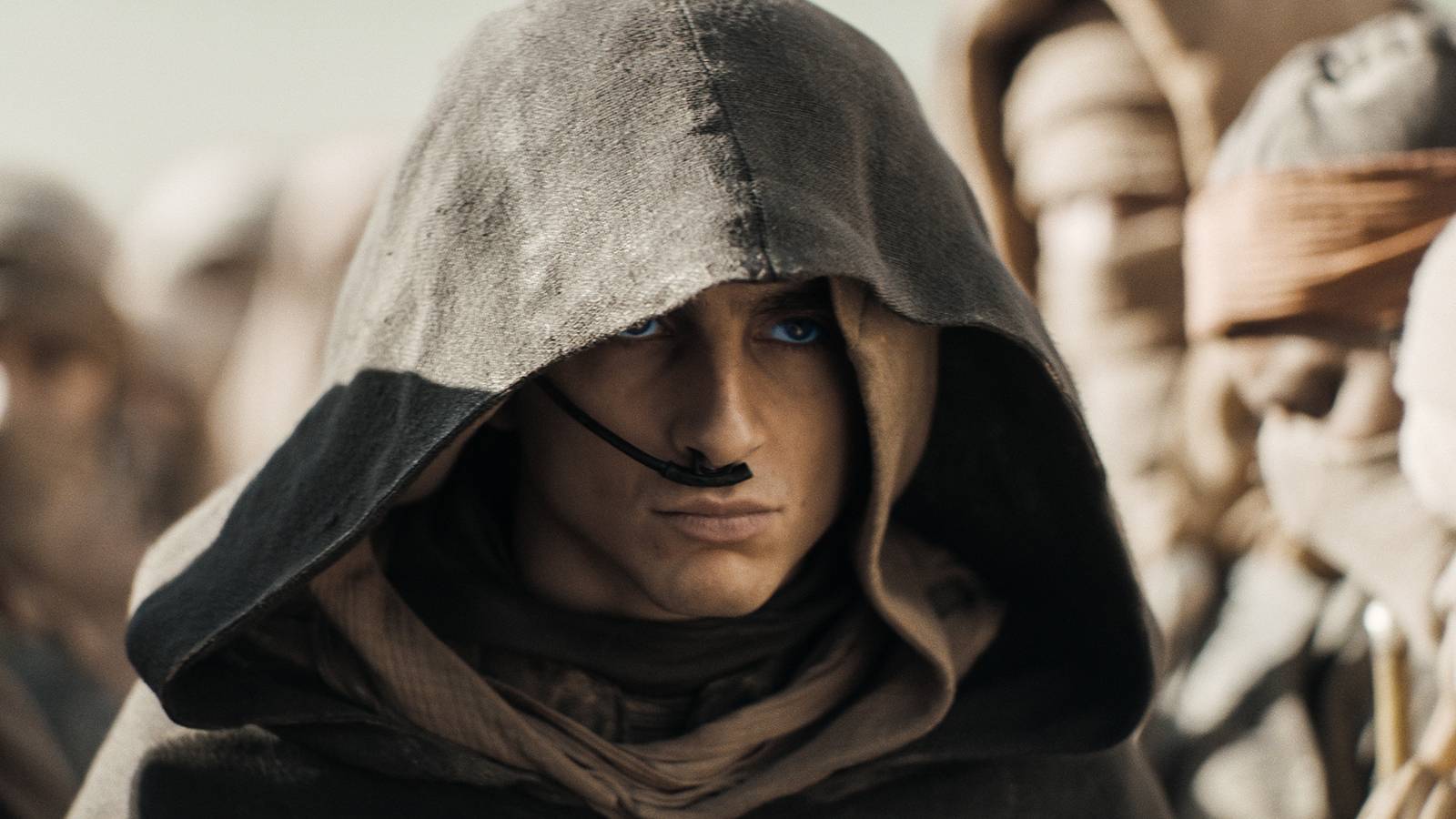
Denis Villeneuve has done what many thought impossible: turned Paul Atreides into a full-blown monster. The messianic hero of Dune: Part One and Dune: Part Two, brought to life by the magnetic Timothée Chalamet, begins as a promising young man and ends as a genocidal dictator, manipulating an indigenous culture for his own gain. Frank Herbert's original novel was always a warning about charismatic leaders, and that's exactly what Paul becomes as we head into Dune: Part Three.
Villeneuve's adaptation nails that message, but it doesn't soften the fact that Paul's story is a tragedy. Wiping out 60 billion lives puts him beyond redemption, yet there's nuance to his arc. That nuance shines through in a quiet moment near the end of Dune: Part Two—the Water of Life scene—where Paul becomes someone he never wanted to be.
It's Already Too Late When Paul Drinks the Water of Life
Some viewers see Paul's decision to go south and take the Water of Life as a simple change of heart. But it's far more complicated. He knows the path leads to war, yet he walks it anyway because he believes he needs the full picture to find a way forward. The real tragedy? By the time he drinks the poison to see all possible futures, it's already too late.
Paul explains this to Lady Jessica (Rebecca Ferguson) with a line that cuts deep: “The visions are clear now. I see possible futures, all at once. Our enemies are all around us, and in so many futures they prevail. But I do see a way. There is a narrow way through.” That moment gets overshadowed by the bombshell that Baron Harkonnen is his grandfather, but it carries weight that the books expand on.
When Paul says their enemies prevail in most futures, he's talking about the deaths of his mother, his sister, and the destruction of the Fremen. He won't accept that. So he chooses the one path that avoids it—even though he knows it will ignite a Holy War. He trades the safety of his family and his adopted people for the lives of billions. It sounds monstrous, but by then, every other option has vanished. In Herbert's novel, Paul's visions show that this Holy War is actually the least terrible outcome. He'll destroy countless worlds, but it's the best-case scenario.
Paul's Sacrifice: Losing Chani to Save the Fremen
Paul's tragedy is that he was forced into this role. His mother decided she would birth the Kwisatz Haderach, never considering the consequences. From birth, he was destined for this horror. That doesn't excuse him—he's fully responsible for his actions, perhaps even more so because he knows exactly what he'll lose.
With full prescience, Paul sees everything: Jessica's secret lineage, the coming war, and what it will do to Chani (Zendaya). He sees every possible future, but only one where his loved ones don't die painfully. Taking the mantle of Lisan al Gaib and seizing the Emperor's throne means losing the love of his life. Chani rejects prophecy and wants Arrakis to be free from outsiders. Paul knows this and takes power anyway, haunted by visions of her death. Losing her is the price he's willing to pay so she and the Fremen can survive.
This choice—sacrificing the person he loves most—is a tragic addition that the first book didn't include. It will weigh on him heavily in Dune: Part Three, as the Holy War razes planets and religions. It doesn't absolve Paul, but it makes him a deeply complex figure, caught in a web woven thousands of years before his birth. For more on how Villeneuve's adaptation deepens the source material, check out our take on other adaptations that nail the source material.